


Gantry Crane Types and Selection Guide
Introduction
Not all gantry cranes are built the same way. Some span a full workshop bay on their own legs. Others run along a factory wall. Some roll across an open yard on rubber tyres, while others ride fixed rails at a busy port terminal.
Picking the wrong type is an expensive mistake. An oversized rail-mounted crane in a small fabrication shop wastes capital and floor space. An underrated portable gantry on a heavy-load line becomes a safety liability and a bottleneck. For procurement managers and facility owners, matching the crane type to the actual work is the single decision that shapes long-term cost, safety, and productivity.
This guide breaks down the five main gantry crane types, explains how their structures differ, and lays out the practical factors that should drive your selection. Whether you are equipping a new facility or replacing aging equipment, you will find a clear framework for narrowing the field to the right system.
What Is a Gantry Crane?
A gantry crane is a lifting system where the bridge girder is supported by freestanding legs that travel along ground-level rails or wheels, rather than on elevated runways attached to the building structure. This design removes the need for load-bearing runway beams built into the walls or roof.
That structural independence is the defining feature. It makes gantry cranes ideal for outdoor yards, open workshops, and facilities where the building itself cannot support an overhead crane’s runway loads. Within that broad category, several distinct configurations serve very different applications.
The 5 Main Types of Industrial Gantry Cranes
1. Full Gantry Crane
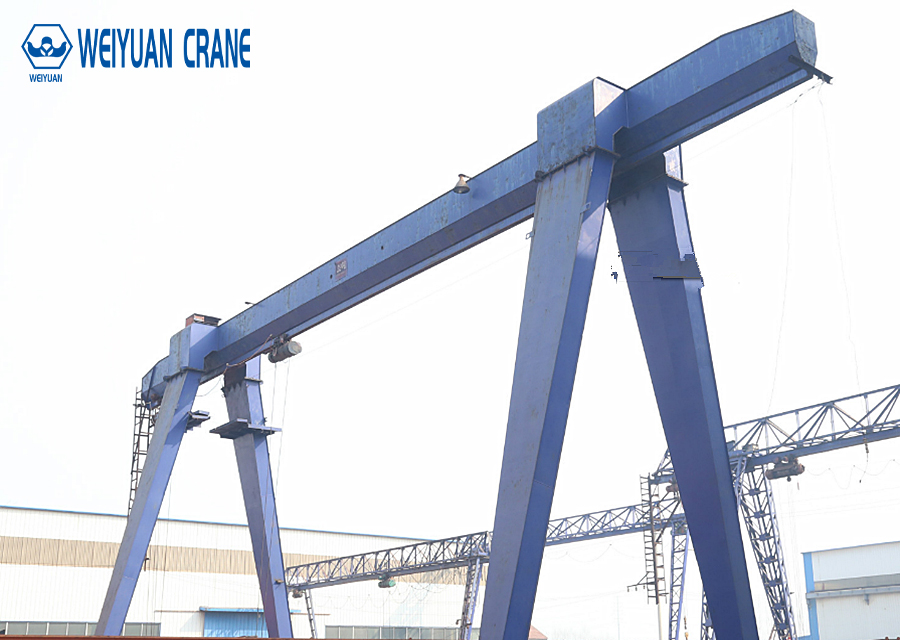
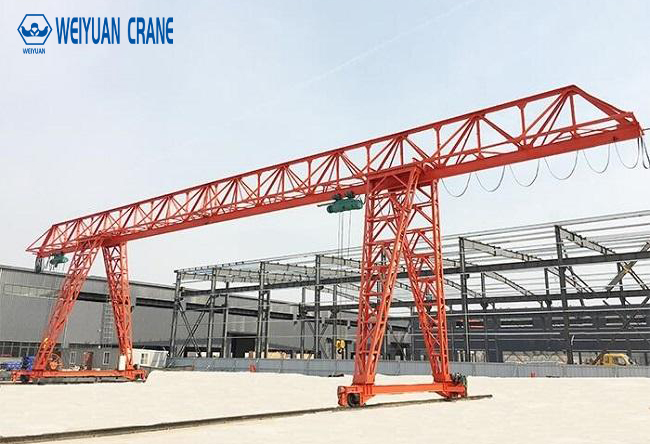
A full gantry crane carries its bridge girder on two supporting legs, both running on ground-level rails. Nothing connects to the surrounding building for support — the crane is entirely self-supporting.
Structural profile: Two legs, two rails, a full span bridging the working area beneath.
Ideal use cases: Heavy fabrication shops, steel yards, shipbuilding, and outdoor storage areas where loads move across a wide open span. Full gantry cranes handle the widest capacity range, from a few tonnes to several hundred tonnes.
Key advantage: Vehicles and equipment can pass beneath the girder and between the legs, keeping the floor space fully usable.
2. Semi-Gantry Crane
A semi-gantry crane is a hybrid. One side runs on a ground-level rail supported by a leg, while the other side rides on an elevated runway mounted to the building wall or existing columns.
Structural profile: One supporting leg on the ground, one end supported by an elevated wall runway.
Ideal use cases: Facilities where floor space is limited on one side but the building structure can carry part of the load. Common in workshops built against a load-bearing wall, or where the crane must share a bay with an existing overhead crane.
Key advantage: Frees up floor space along the wall side and often costs less than a full gantry because it uses only one leg assembly.
3. Portable and Adjustable Gantry Crane
Portable gantry cranes are lightweight, movable systems, often mounted on casters rather than rails. Many models offer adjustable height and span to adapt to different tasks.
Structural profile: Compact frame on wheels or casters, typically aluminum or lightweight steel, with manual or light-powered hoists.
Ideal use cases: Maintenance departments, small workshops, engine rooms, and any setting where lifts are occasional and loads are modest — usually under 5 tonnes.
Key advantage: Flexibility. The crane rolls to where the work is, sets up in minutes, and stores away when idle. Ideal for facilities that need lifting capacity without a permanent installation.
4. Rubber-Tyred Gantry Crane (RTG)
Rubber-tyred gantry cranes move on wheeled tyres rather than fixed rails, giving them freedom to travel across paved yards and reposition between working areas.
Structural profile: Large freestanding gantry on multiple rubber tyres, typically diesel-electric or increasingly electric-powered.
Ideal use cases: Container terminals, intermodal yards, and large storage facilities where the crane must stack loads across multiple rows and relocate between blocks. RTGs are a mainstay of container handling worldwide.
Key advantage: Mobility without the cost of laying rail. An RTG can serve several stacking lanes and shift to where demand is highest.
5. Rail-Mounted Gantry Crane (RMG)
Rail-mounted gantry cranes run on fixed steel rails set into the ground. The rails constrain the travel path but deliver precision and high sustained throughput.
Structural profile: Heavy freestanding gantry on steel wheels running fixed ground rails, usually electric-powered through a cable reel or conductor bar.
Ideal use cases: High-volume container terminals, rail freight yards, and automated storage facilities where the crane repeats the same travel path continuously. RMGs support higher capacities and faster cycle times than RTGs.
Key advantage: Precision, energy efficiency, and readiness for automation. Because the travel path is fixed, RMGs integrate smoothly with automated positioning and control systems.
How to Select the Right Gantry Crane
Choosing the right type comes down to matching the equipment to your operating reality. Work through these factors before committing to any configuration.
Load capacity and lift frequency
Start with the heaviest load the crane will handle, then factor in how often lifts occur. A portable gantry suits occasional light lifts, while continuous heavy handling demands a full gantry or RMG built for high duty cycles. Always include the weight of spreader beams, lifting frames, and rigging in your capacity calculation, plus a sensible safety margin.
Span and lifting height
Measure the working area the crane must cover — the span between supports and the required hook height. Wide open spans point toward full gantry systems. Height clearance constraints may rule out taller configurations and favor lower-profile designs.
Indoor versus outdoor operation
Outdoor installations need weatherproofing, corrosion-resistant finishes, and often diesel or hybrid power where grid access is limited. Indoor cranes can rely on cleaner electric drives and lighter structures. RTGs and RMGs are built almost exclusively for outdoor yard work.
Mobility requirements
Ask how much the crane needs to move. A fixed rail path suits repetitive, high-volume work (RMG). Free movement across a yard calls for rubber tyres (RTG). Occasional relocation within a small shop points to a portable unit.
Building structure and floor space
If your building cannot carry runway loads, a full gantry is the answer. If one wall can bear part of the load and you want to preserve floor space, a semi-gantry offers a cost-effective compromise.
Total cost of ownership
Look beyond the purchase price. Factor in installation, rail or foundation work, power supply, maintenance, and expected service life. An RMG carries higher upfront cost than an RTG but often delivers lower operating cost and better energy efficiency over a 10-to-15-year horizon.
Frequently Asked Questions
Q: What is the difference between a full gantry and a semi-gantry crane?
A full gantry crane stands on two legs running on ground rails, completely independent of the building. A semi-gantry crane uses one ground-level leg while the opposite end rides on an elevated runway attached to the building wall or columns. Semi-gantry systems suit facilities with limited floor space on one side and a structure capable of carrying part of the load, and they typically cost less because they use a single leg assembly.
Q: When should I choose a rubber-tyred gantry over a rail-mounted gantry?
Choose a rubber-tyred gantry (RTG) when you need mobility across a paved yard and want to avoid the cost of laying fixed rails — for example, a container yard where the crane must serve several stacking blocks. Choose a rail-mounted gantry (RMG) for high-volume, repetitive operations on a fixed path, where precision, energy efficiency, and automation readiness justify the rail infrastructure investment.
Q: What capacity range do industrial gantry cranes cover?
Portable and adjustable gantries typically handle light loads under 5 tonnes. Full gantry cranes span the widest range, from a few tonnes to several hundred tonnes for heavy fabrication and shipbuilding. Rubber-tyred and rail-mounted gantries in container handling commonly work in the 40-to-65 tonne range, with heavy-duty RMGs going higher for specialized applications.
Q: Can a gantry crane be installed outdoors?
Yes. Many gantry cranes are designed specifically for outdoor use, with weatherproof enclosures, corrosion-resistant coatings, and power options suited to yards without full grid access. Rubber-tyred and rail-mounted gantries are almost always outdoor equipment, while full gantry cranes are widely used in both indoor workshops and outdoor storage yards.
Conclusion
The right gantry crane is the one matched to your loads, your site, and the way your team actually works. Full and semi-gantry cranes serve fabrication and workshop settings. Portable units bring flexible lifting to maintenance and light-duty tasks. Rubber-tyred and rail-mounted gantries dominate container and yard handling, each trading mobility against precision.
Getting the selection right protects your capital, keeps your workforce safe, and keeps loads moving without bottlenecks. The wrong choice quietly drains budget and productivity for years.
Ready to identify the right gantry crane for your facility? Contact our engineering team for a free consultation. We will assess your load profile, site conditions, and operational goals, then recommend the configuration that delivers the best return on your investment.
Meta data
Meta title
Gantry Crane Types and Selection Guide for Industry
Meta description
Compare the main gantry crane types — full, semi, portable, rubber-tyred, and rail-mounted — and learn how to select the right industrial gantry crane for your facility.