


Gantry Crane Types & Selection Guide
Introduction
A steel service center I visited had made what looked like a smart call. They needed to move plate and structural sections around an open storage yard, and rather than build a fixed overhead crane with all its runway steel and support columns, they bought a full gantry crane. Sound logic — a gantry stands on its own legs, no building structure required. The problem showed up six months later, and it wasn’t the crane. It was the ground.
They had specified a rail-mounted gantry and laid two rail beams on a foundation sized for the crane’s static wheel loads. What nobody had accounted for was that half their yard was compacted fill that settled unevenly through the first wet winter. The rails drifted out of level, the crane started skewing on its wheels, and within a year they were grinding flanges and tripping travel motors — the exact failure a rubber-tired unit on a prepared running surface would have shrugged off. The crane was fine. The type was wrong for the site.
That’s the trap with gantry cranes. They look like a single product with a capacity number, but “gantry crane” covers at least five structurally different machines, each suited to a different span, site, and duty. Choose the configuration that fits your building, your ground, and your workflow, and the crane disappears into the background for twenty years. Choose the wrong one and you fight it — on the rails, in the budget, or in the downtime — for its whole life.
This is the first article in a three-part gantry crane series. Here we cover the decisions that shape the crane before you compare a single price: the types and how they differ structurally, the span and capacity logic that sizes the machine, the duty class that decides whether it lasts, and the site conditions that quietly rule some types in and others out. Nail these and comparing quotes becomes straightforward instead of guesswork.
What you’ll take away:
- The five main gantry types — full, semi, rail-mounted, rubber-tired, and portable — and where each earns its place
- How single-girder and double-girder configurations change cost, headroom, and capacity
- How to size span and capacity for the real job, cantilevers included
- How to match CMAA (A–F) and FEM/ISO (M3–M8) duty class to how hard the crane will actually work
- Why the ground under the crane decides the type as much as the load above it
- 2026 pricing so your budget survives the first supplier conversation
Part 1: The Five Main Gantry Crane Types
Every gantry crane shares one defining feature: a bridge that carries the hoist, held up by legs that stand on the ground or a runway, rather than by an elevated runway bolted to a building. That’s what separates a gantry from an overhead crane. Beyond that shared idea, the five common types diverge sharply — and the difference is structural, not cosmetic.
Full Gantry Crane
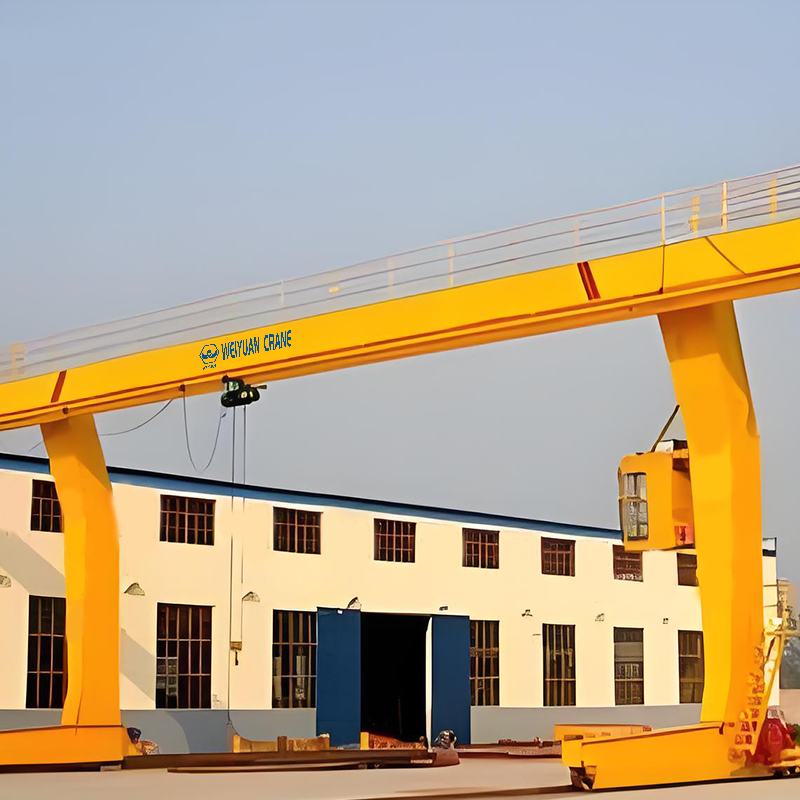
The classic configuration. The bridge sits on two legs, both of which travel on rails set at ground level, one on each side of the working area. The crane straddles the entire span, and the space beneath the bridge is completely open — vehicles, rail cars, and stored material pass straight through.
Where it earns its place: open yards, container and storage areas, precast concrete plants, and any operation that needs to load and unload ground-level transport across a wide span. When you want the whole footprint under the crane usable and unobstructed, a full gantry is the answer.
Semi-Gantry Crane
A hybrid. One side of the bridge rides on a ground-level rail like a full gantry; the other side runs on an elevated runway beam mounted to a building wall or a line of columns. So one leg stands tall on the ground, and the other end is carried up high by the building.
Where it earns its place: buildings where a wall or column line already exists on one side but there’s no support on the other, or where you want to keep floor space clear on the building side while still spanning open ground on the yard side. A semi-gantry uses less floor area than a full gantry because only one leg lives at ground level.
Rail-Mounted Gantry (RMG)
A full gantry built for heavy, high-frequency duty, running on fixed steel rails set into a prepared foundation. The rails give precise, repeatable travel and carry very high wheel loads, which is why RMGs handle the biggest capacities and the most demanding cycles.
Where it earns its place: container terminals stacking intermodal boxes, heavy rail yards, and large-scale storage operations where the crane runs a fixed path all day, every day. The fixed rail is both its strength — accuracy and capacity — and its constraint: the path can’t change without relaying track.
Rubber-Tired Gantry (RTG)
A gantry that travels on rubber tires rather than rails, driven by its own diesel or electric power unit. It steers, so it can move between working areas and reposition across a yard without any track at all.
Where it earns its place: container yards and storage operations that need flexibility — the ability to shift the crane to a different stack, a different lane, or a different part of the site. An RTG trades the RMG’s pinpoint rail accuracy for the freedom to go where the track doesn’t.
Portable (Adjustable) Gantry Crane
A small, often lightweight gantry — frequently aluminum or light steel — mounted on casters, that a small team can move by hand or break down and relocate. Many offer adjustable height and span.
Where it earns its place: workshops, maintenance bays, engine rooms, and light assembly where an occasional lift of a few hundred kilos to a few tonnes is needed at a spot that changes. It’s the gantry you roll to the job rather than build the job around.
Quick Type Comparison
| Type | Travels on | Typical capacity | Best for |
|---|---|---|---|
| Full gantry | Two ground rails | 5 – 100+ t | Open yards, straddling transport |
| Semi-gantry | One ground rail + one elevated runway | 5 – 50 t | Buildings with support on one side |
| Rail-mounted (RMG) | Fixed heavy rails | 30 – 100+ t | Container terminals, heavy fixed-path duty |
| Rubber-tired (RTG) | Rubber tires (self-driven) | 30 – 65 t | Flexible container/yard operations |
| Portable | Casters | 0.25 – 5 t | Workshops, maintenance, occasional lifts |
Mini-takeaway: the type is a structural and site decision before it’s a capacity one. Full and semi-gantries suit spanning fixed working areas; RMGs suit heavy fixed-path duty; RTGs suit flexible yards; portables suit light, mobile lifts. Settle the type first — everything downstream sits on top of it.
Part 2: Single-Girder vs. Double-Girder — The Configuration That Shapes Cost
Within most gantry types, the next fork is the bridge itself: does it use one main girder or two? This choice drives capacity, hook height, and a meaningful slice of the price, and it follows much the same logic across gantry cranes as it does across bridge cranes generally.
Single-Girder Gantry
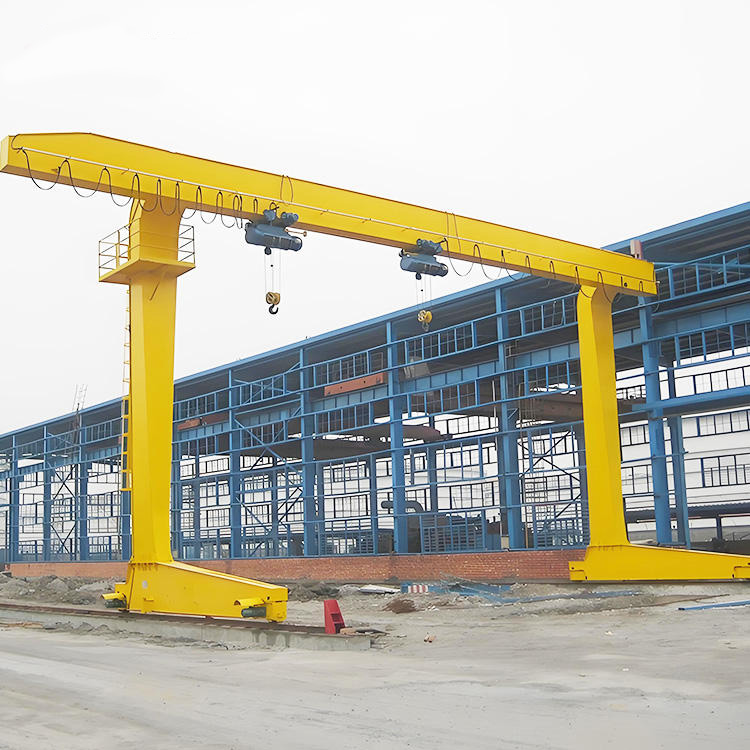
One main bridge girder carries a hoist that runs along the girder’s lower flange (or on a trolley beneath it). Lighter, simpler, and cheaper.
   SINGLE GIRDER

   ┌──────────────────────────┐  ← one main girder
   │                          │
   │        [hoist]           │
   │           │              │
   ▟           ▼              ▙
   █                          █   ← legs
  ═╪═════════════════════════╪═   ← ground rails
Where it earns its place: capacities up to roughly 20 tonnes and moderate spans. The single girder keeps the dead weight down, which means lighter legs, smaller wheel loads, and a lighter foundation — cost savings that compound down the whole structure.
The trade-off: because the hoist hangs below the girder rather than running up between two girders, single-girder cranes give up some hook height, and they’re limited on capacity and span before deflection becomes a problem.
Double-Girder Gantry
Two parallel main girders carry a trolley that rides on top, between them, with the hoist mounted on the trolley.
   DOUBLE GIRDER

   ┌──────────[trolley]──────────┐  ← two girders, trolley on top
   ╞═════════════════════════════╡
   │            │                │
   ▟            ▼                ▙
   █                             █   ← legs
  ═╪══════════════════════════════╪═   ← ground rails
Where it earns its place: heavier capacities (above ~20 tonnes), longer spans, and any duty where you need maximum hook height or room for a maintenance walkway on the bridge. The trolley riding on top lets the hook pull up between the girders, recovering lift height a single-girder crane loses.
The trade-off: more steel, more weight, higher wheel loads, a bigger foundation, and a higher price. You pay for capability you should only buy if the capacity, span, or hook-height demands it.
Choosing Between Them
| Factor | Single-girder | Double-girder |
|---|---|---|
| Capacity | Up to ~20 t | 20 t and well beyond |
| Span | Short to moderate | Moderate to long |
| Hook height | Reduced (hoist below girder) | Maximum (hoist between girders) |
| Dead weight & wheel loads | Lower | Higher |
| Foundation cost | Lower | Higher |
| Purchase cost | Lower | Higher |
Mini-takeaway: default to single-girder and let the requirement force you up to double-girder — not the other way around. If your capacity is under ~20 tonnes, your span is moderate, and you don’t need the extra hook height, single-girder saves money at every level of the structure. Above that, double-girder earns its cost.
Part 3: Span and Capacity — Sizing the Machine to the Job
With the type and girder configuration settled, the two numbers that size the crane are span and capacity. Both look simple and both hide the same trap: buyers measure the obvious dimension and forget the parts of the job that push the real requirement higher.
Defining Span Correctly
Span is the distance between the centers of the two rails (or, for a semi-gantry, between the ground rail and the elevated runway). It sets how wide a working area the crane straddles — and it drives girder size, because a longer span means more bending, which means a deeper, heavier girder to keep deflection in check.
The common error is specifying span to just cover the material and forgetting clearances. Your span has to cover:
- The full working width the load must travel across
- Clearance to any transport that passes through — trucks, rail cars, trailers
- Safe clearance between the legs and any fixed obstruction, stored stacks, or aisle
Undersize the span and the crane can’t reach the edges of the work area; oversize it and you pay for girder steel and wheel-load capacity you never use. Measure the real working envelope, add the clearances, and that’s your span.
Don’t Forget the Cantilever
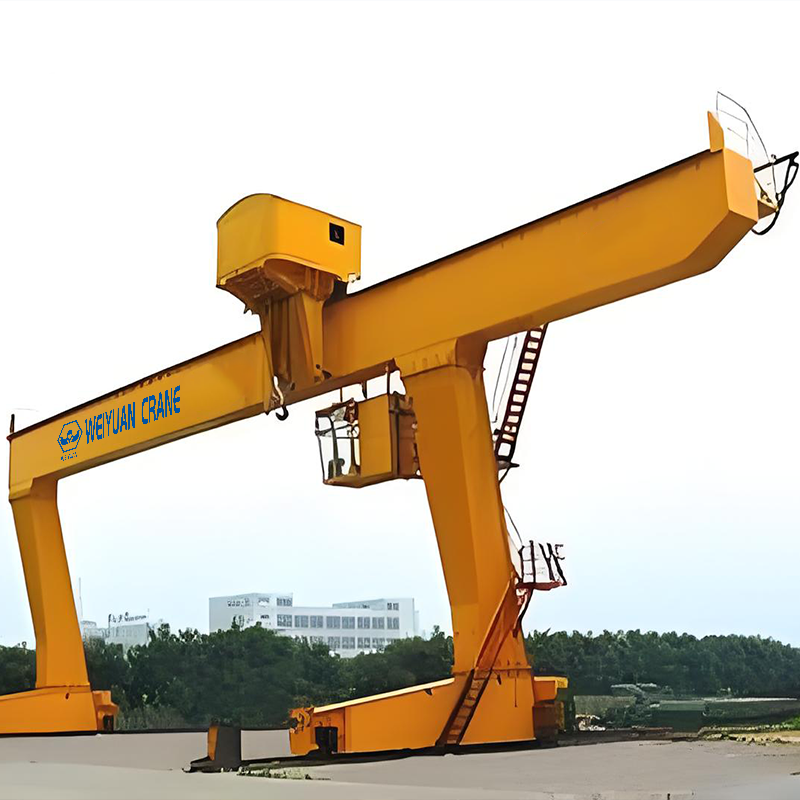
Many gantry cranes carry a cantilever — a section of girder that extends beyond one or both legs, so the hoist can reach outside the rail line. This is how a gantry loads a truck parked alongside the rails rather than only between them.
If your workflow needs the hook to reach outside the legs — to a loading lane, a delivery bay, an outboard storage row — specify the cantilever reach explicitly. A cantilevered load applies its own bending and overturning effect on the structure, so it’s a design input, not an afterthought. Tell your supplier the outboard reach and load the cantilever must handle up front.
Sizing Capacity to the Real Suspended Load
Capacity goes wrong most often because buyers rate against the bare weight of the load and forget everything else on the hook. Your rated capacity has to cover the whole suspended load:
- The heaviest load you’ll actually lift — not the average one
- The below-hook device: spreader beam, lifting frame, magnet, grab, or C-hook
- The rigging: slings, shackles, and hooks in the load path
A spreader beam or lifting frame on a yard gantry can weigh well into the hundreds of kilos. Leave it out and a “20-tonne” crane lifting a 20-tonne load on a 700 kg spreader is quietly overloaded on the exact job it was bought for.
The disciplined sequence:
- Add up the total suspended load: heaviest load + below-hook device + rigging.
- Divide by 0.8 to leave working margin — aim to run the crane at around 80% of rated capacity in normal service.
- Round up to the next standard capacity step (5, 10, 16, 20, 32, 50 tonnes, and so on).
Standard steps keep you on catalog components — lower cost, faster delivery, easier spares — where an odd figure means a custom quote and a longer wait.
Mini-takeaway: span is the working width plus clearances plus any cantilever reach; capacity is the whole suspended load, sized for the heaviest lift, with margin, rounded up. Measure the real envelope on both, and the crane fits the job instead of fighting it.
Part 4: Duty Class — The Number That Decides Whether the Crane Lasts
If you take one thing from this article, make it this: duty class, not capacity, determines a gantry crane’s service life. Two cranes can carry identical tonnage over an identical span and belong to completely different worlds of construction, cost, and longevity — because one is built to work occasionally and the other to work constantly.
Duty class rates how hard a crane is engineered to work over its lifetime. It combines two factors buyers routinely overlook:
- Load spectrum — how heavy the average lift is relative to rated capacity. A crane that mostly lifts light loads with the occasional heavy one lives an easier life than one running near capacity every cycle.
- Operating frequency — how many lift cycles the crane performs per hour, per shift, per day. Occasional lifts are gentle; continuous cycling is punishing.
Get honest about both before specifying anything — not how you’d like to imagine the crane running, but how it will actually run once the yard is at full production.
The Two Systems: CMAA and FEM/ISO
Gantry cranes are classified under the North American CMAA system (Classes A–F) and the European/international FEM/ISO system (groups M3–M8). They measure the same thing — how hard the crane works — using different frameworks, and they cross-reference closely.
| Service level | CMAA class | FEM/ISO group | Typical gantry usage |
|---|---|---|---|
| Standby / infrequent | A | M3 (1Bm) | Occasional lifts, long idle periods |
| Light | B | M4 (1Am) | Light yard work, single shift |
| Moderate | C | M5 (2m) | Steady yard or workshop lifting |
| Heavy | D | M6 (3m) | Frequent heavy lifting, precast plants |
| Severe | E | M7 (4m) | Near-continuous duty, busy terminals |
| Continuous severe | F | M8 (5m) | Around-the-clock container/steel handling |
Placing Your Operation
Three questions settle the class for most buyers:
- How many lifts per hour, per shift? A handful a day points to CMAA A–B / M3–M4. Steady lifting through the shift is C / M5. Near-continuous cycling is D–F / M6–M8.
- How heavy are the lifts relative to capacity? Mostly light with the odd heavy one is easy duty. Consistently near rated capacity pushes the class up regardless of frequency.
- How many shifts? A single-shift yard and a three-shift terminal moving the same tonnage are worlds apart on duty. Running hours compound wear.
Why This Is a Budget Decision
Under-specifying duty class is the single most expensive gantry procurement error — and it doesn’t show on day one. It shows in year two, as hoists, brakes, wheels, and travel drives wear out far ahead of schedule and the unplanned downtime costs more than the crane. Over-specifying costs you too: paying for a Class F / M8 crane to do genuine Class C / M5 work burns capital you could deploy elsewhere.
The procurement discipline that catches most bad “bargains”: when you compare quotes, normalize them to the same duty class. A cheaper crane at a lower duty rating isn’t a like-for-like comparison — it’s a different product that happens to share a tonnage and span figure. That one check protects you from the exact mistake that turns a twenty-year asset into a two-year liability.
Mini-takeaway: capacity gets the crane onto the shortlist; duty class decides whether it survives your yard. Match CMAA A–F or FEM/ISO M3–M8 to your busiest realistic operation, and if usage is uncertain, round up rather than down.
Part 5: Site Conditions — The Ground Decides the Type
Here’s the factor that ruled the steel service center’s crane out of trouble, if only they’d weighed it: the ground and the site often decide the gantry type more firmly than the load does. A crane can be perfectly specified on capacity, span, and duty, and still fail because the running surface underneath it couldn’t hold the crane true.
Rails vs. Wheels — Match the Type to the Surface
The single biggest site decision is whether the crane runs on fixed rails (full gantry, semi-gantry, RMG) or rubber tires (RTG). And that choice hinges on the ground:
- Rails demand a stable, level, engineered foundation. The wheels are rigid steel on rigid rail, with almost no tolerance for misalignment. If the ground settles unevenly — as the steel center’s compacted fill did — the rails drift out of level and gauge, and the crane skews, grinds its flanges, and overloads its travel motors. A rail-mounted crane is only as good as the foundation holding its track true.
- Rubber tires forgive minor surface variation and need no track at all — but they demand a prepared, load-bearing running surface (typically a reinforced concrete pavement or a compacted, stabilized base) that can carry the concentrated wheel loads without rutting. RTGs trade rail accuracy for the freedom to reposition, but they don’t tolerate soft or unprepared ground either.
Indoor vs. Outdoor Exposure
Where the crane lives changes its specification:
- Outdoor cranes face wind, rain, and temperature swings. Outdoor gantries usually need wind-load design (and often rail clamps or storm anchors that lock the crane down in high wind), weatherproof electrical protection, and a corrosion-resistant coating system rather than a plain indoor finish.
- Indoor cranes avoid weather but face their own limits — ceiling clearance capping crane height and hook height, and the building’s own structure to work around.
Wheel Loads and the Foundation
Whatever the type, the crane concentrates its whole weight — dead weight plus the lifted load plus dynamic impact — onto a handful of wheels, and that force goes straight into the ground or the rail foundation. The heavier the crane and load, the more critical the foundation.
Get the maximum and minimum wheel loads from your supplier during specification, and hand them to a geotechnical or structural engineer before you commit to a type and layout. On a marginal site, the wheel-load reality may push you from a rail-mounted crane (which needs a substantial, settlement-free foundation) toward a rubber-tired unit on a prepared pavement — or force a foundation upgrade you’d rather know about before the order than after the first wet winter.
Mini-takeaway: the ground is a specification input, not a given. Match rails to stable engineered foundations and tires to prepared load-bearing pavement; design for weather if the crane lives outdoors; and verify wheel loads against the actual site before you lock in the type. The load above the crane matters — but the ground beneath it decides just as much.
Part 6: 2026 Price Reference for Gantry Cranes
Use these as planning figures to build a defensible budget before you approach suppliers. Actual pricing moves with capacity, span, duty class, girder configuration, and — critically — the rail foundation or running surface, which is often a separate civil cost. Turnkey installed ranges include freight, rail or running-surface works, electrification, field assembly, and load-test certification where applicable.
| Configuration | Capacity / Span | Equipment only (USD) | Turnkey installed (USD) |
|---|---|---|---|
| Portable (adjustable) gantry | 1 t / 3–4 m | $1,500 – $6,000 | $2,000 – $8,000 |
| Single-girder full gantry | 5 t / 12 m | $18,000 – $35,000 | $30,000 – $55,000 |
| Single-girder semi-gantry | 10 t / 15 m | $28,000 – $50,000 | $45,000 – $80,000 |
| Double-girder full gantry (Class C) | 20 t / 20 m | $70,000 – $130,000 | $110,000 – $200,000 |
| Double-girder full gantry (Class D) | 32 t / 25 m | $120,000 – $220,000 | $180,000 – $320,000 |
| Rubber-tired gantry (RTG) | 40 t / container span | $400,000 – $900,000 | $500,000 – $1,200,000+ |
| Rail-mounted gantry (RMG), heavy duty | 50 t+ / long span | $600,000 – $1,500,000 | $800,000 – $2,000,000+ |
Cost drivers worth building into the budget:
- Double-girder over single-girder: substantial, through heavier girders, legs, wheels, and foundation — buy it only when capacity, span, or hook height demands it.
- Higher duty class (e.g., Class C to Class E): often +20 to 50%, reflecting heavier structure, higher-rated hoists, and more robust travel drives.
- Rail foundation or running surface: a real civil cost that can rival the crane itself, especially for RMGs and any crane on marginal ground. Frequently quoted separately — confirm what’s in and what’s out.
- Outdoor package: wind-load design, rail clamps or storm anchors, weatherproof electrics, and corrosion coating add cost over an indoor unit.
- Cantilever reach: extending the girder beyond the legs adds steel and design load — priced per the outboard reach and load.
Procurement tip: the gap between an “equipment only” quote and a “turnkey installed” quote is where gantry budgets get ambushed — and on gantries, the foundation or running surface is the biggest hidden line. When you compare suppliers, normalize every quote to the same capacity, span, duty class, girder configuration, and the same civil scope. A headline price that looks 20% cheaper often reflects a lower duty class, a single-girder build, or an excluded foundation — not a genuine saving.
Frequently Asked Questions
Q: What’s the difference between a full gantry and a semi-gantry crane?
A: It comes down to how each end of the bridge is supported. A full gantry stands on two legs, both traveling on ground-level rails, so it straddles the entire working area with open space beneath it — ideal for open yards where transport passes through. A semi-gantry supports one side on a ground rail and the other on an elevated runway mounted to a building wall or column line, so only one leg lives at ground level. Choose a full gantry when you’re spanning open ground with no structure to lean on; choose a semi-gantry when a wall or column line already exists on one side and you want to save the floor space a second ground leg would occupy.
Q: When should I choose a rubber-tired gantry (RTG) over a rail-mounted gantry (RMG)?
A: Let flexibility versus fixed-path accuracy decide, and let the ground confirm it. Choose an RTG when you need to reposition the crane around a yard — moving between stacks, lanes, or areas — because it steers on tires and needs no track, though it does need a prepared, load-bearing running surface. Choose an RMG when the crane runs a fixed, repeatable path all day at high capacity and high frequency, as at a container terminal or heavy rail yard; the fixed rail gives pinpoint accuracy and carries the biggest wheel loads, but it demands a substantial, settlement-free foundation and can’t change its path without relaying track.
Q: Do I need a single-girder or double-girder gantry crane?
A: Default to single-girder and let the requirement force you up. Single-girder suits capacities up to roughly 20 tonnes and moderate spans — it’s lighter, cheaper, and carries lower wheel loads and a lighter foundation right down the structure. Move to double-girder when you need capacity above about 20 tonnes, longer spans, maximum hook height (the trolley rides on top so the hook pulls up between the girders), or room for a maintenance walkway on the bridge. Double-girder costs more at every level, so buy it only when the capacity, span, or hook height genuinely calls for it.
Q: How do I match a gantry crane’s duty class to my operation?
A: Match it to how hard the crane will really work, using three questions: lifts per hour and per shift, how close the average lift is to rated capacity, and how many shifts you run. Occasional lifting with long idle periods is CMAA Class A–B / FEM M3–M4. Steady lifting through the shift is Class C / M5. Near-continuous cycling at higher loads across multiple shifts is Class D–F / M6–M8, typical of busy terminals and precast plants. Under-rating the duty class is the most common and most expensive gantry mistake, because the failure shows up in year two as premature wear, not on day one — so if usage is uncertain, round up rather than down.
Q: Why does the ground under a gantry crane matter so much?
A: Because a gantry stands on its own legs and concentrates its entire weight — dead weight plus load plus dynamic impact — onto a few wheels, and that force goes straight into the ground or rail foundation. Rail-mounted cranes are unforgiving: steel wheels on steel rail have almost no tolerance for misalignment, so if the ground settles unevenly the rails drift out of level and the crane skews, grinding flanges and overloading travel motors. Rubber-tired cranes tolerate minor surface variation but still need a prepared, load-bearing pavement. Get the wheel loads from your supplier and have a geotechnical or structural engineer confirm the ground before you commit to a type — a marginal site can rule out a rail-mounted crane entirely.