


How to Choose KBK Crane Capacity and Track Layout: A Specification Guide for Plant Engineers and Procurement Managers
Introduction
A KBK crane specification goes wrong in two quiet, expensive ways. Either the capacity gets sized to the bare load — and the system runs overloaded the moment an air balancer and a spreader join it below the hook — or the layout gets designed for today’s floor plan and boxes in a line that grows six months later. Both mistakes hide until they cost you: one as premature wear, the other as an early, avoidable replacement.
For procurement managers, plant engineers, and facility managers, specifying a KBK system is not about picking a capacity off a chart. It is about matching four things at once — the true load, the coverage geometry, the duty cycle, and the environment — then designing a track and support structure that carries all of them safely and adapts as your operation changes.
This is article 3 of 3 in the Weiyuan Crane KBK crane deep-dive series. Where the KBK vs Jib Crane article helped you choose the system type and the KBK for assembly line workstations guide covered line configuration, this one turns the choice into a precise, defensible specification. Here is what you will learn:
- How to calculate true capacity including all rigging
- Why KBK load ratings differ from overhead crane ratings
- How to map coverage to configuration and plan the track and support structure
- How duty class, environment, and future growth shape the final spec
How to Calculate Required Capacity
The single most common KBK specification error is sizing on the bare load. Your required capacity is never just the heaviest thing you lift — it is that load plus everything hanging below the hook, plus a margin.
What Counts Against the Rating
On a KBK system, everything below the hook consumes capacity:
- The hoist itself — the electric chain hoist, air balancer, or vacuum lifter.
- The lifting device — spreader beam, lifting frame, tooling, or vacuum head.
- The rigging — slings, shackles, and connectors.
- A safety margin — headroom for load variation and future growth.
Here is why this matters more on KBK than on any heavy crane: the system tops out around 2,000 kg. On a light rating, an air balancer or vacuum lifter can be a meaningful share of the total. A 300 kg load with a 120 kg vacuum lifter and a 40 kg frame needs 460 kg of capacity before any margin — over 50% more than the bare load.
The Calculation
Use this simple rule for every station:
Required capacity = heaviest load + hoist + lifting device + rigging + safety margin
Work it out for the busiest and heaviest station on the system, since one rating usually covers the whole run. Then confirm the total sits comfortably within the KBK range, not at its very edge. The KBK buying guide walks through this calculation with worked examples.
Takeaway: Size on the load plus all rigging plus a margin — never the bare load. On a light KBK system, forgotten rigging weight overloads the rating faster than on any other crane.
Understanding KBK Load Ratings
A KBK rating is not directly comparable to an overhead crane rating, and treating them as interchangeable leads to poor decisions. Understanding the difference protects your specification.
Why the Ratings Differ
An overhead crane is a heavy, top-running structure carried on a building’s runway beams, rated for tonnes and built for structural lifting. A KBK system is a suspended, modular, light-duty solution built from enclosed steel profiles that hang from the roof. Its ratings reflect that design:
- Lighter capacity band — typically up to ~2,000 kg, versus tens or hundreds of tonnes for overhead cranes.
- Suspension-based load path — the load transfers up through suspension points into the roof, not down through columns into the floor.
- Ergonomic priority — the rating assumes light, frequent, hand-guided motion, not heavy structural lifts.
What the Rating Actually Governs
On KBK, the published capacity governs more than the hoist. It sets the limits on the track profile, the trolley, the bridge length, and the suspension point spacing together, because they form one load path. Exceed the rating and you are not just overloading a hoist — you are overloading the whole suspended structure and the roof it hangs from.
This is why you cannot simply “upgrade the hoist” on an existing KBK run to lift more. The track profile and suspension were sized to the original rating. For the full picture of how the modular profiles are rated and combined, see the KBK types guide.
Takeaway: A KBK rating governs the whole suspended load path — track, trolley, bridge, and suspension — not just the hoist. Never treat it as equivalent to an overhead crane rating.
Mapping Coverage to Configuration
Once capacity is settled, the next decision is coverage geometry: how the lift needs to reach across your floor. This determines whether you specify a monorail, a single-girder suspension crane, or a full grid.
Monorail: Straight-Line Transfer
A monorail is a single track carrying a hoist along a straight path. It is the simplest, lowest-cost layout, and it fits a genuinely linear workflow — moving a part from one operation to the next in a straight line, with no side-to-side reach.
Choose a monorail when the load travels a fixed, straight route and never needs to deviate.
Single-Girder Suspension Crane: Area Coverage
A single-girder suspension crane adds a bridge that travels along two runway tracks, covering a defined rectangle with two-axis reach. It suits a workstation or cell where the operator picks from one point and places at another anywhere within a bounded footprint.
Choose this for an individual cell that needs full coverage of its own area.
Full Grid: Whole-Floor Coverage
A full grid links multiple bridges across shared runways, covering an entire bay with no dead spots. Each operator works their own zone, and loads hand off between adjacent areas.
Choose a grid for a large, multi-station floor where every point needs coverage.
The Practical Test
Lay your real work path over each shape. A straight line points to a monorail; a bounded rectangle points to a suspension crane; a whole floor of stations points to a grid. Design to the actual material flow, not a tidy geometric ideal.
Takeaway: Coverage geometry decides configuration — monorail for straight paths, suspension crane for a bounded cell, grid for a whole floor. Trace your real work path to see which shape fits.
Track Layout Planning
With capacity and configuration set, you design the physical track. Four dimensions drive a sound layout, and each ties back to the load rating.
Runway Spans
The runway span is the distance between suspension points along each runway track. Wider spacing uses fewer suspension points but increases the load each one carries and the deflection between them. The span must stay within the profile’s rated limit for your load — a heavier rating means closer suspension points. Never stretch spans to save on hardware, because excess deflection makes the bridge hard to move and stresses the track.
Bridge Length
The bridge length is the span the traveling bridge covers between the two runways. Longer bridges give wider coverage but carry more load and deflect more at the center, which can reduce the rated capacity. Match the bridge length to the coverage you genuinely need, since an over-long bridge sacrifices capacity for reach you may not use.
Suspension Point Spacing
Suspension points transfer the entire system load into the roof. Their spacing follows the profile rating and the load, and it must align with the building’s structural members — a suspension point does no good hanging between roof trusses. Map the points against the real roof structure early, because this often shapes the whole layout.
Support Structure Requirements
Every KBK system needs a sound structure to hang from:
- Roof suspension — where existing roof steel is verified to carry the loads at every point.
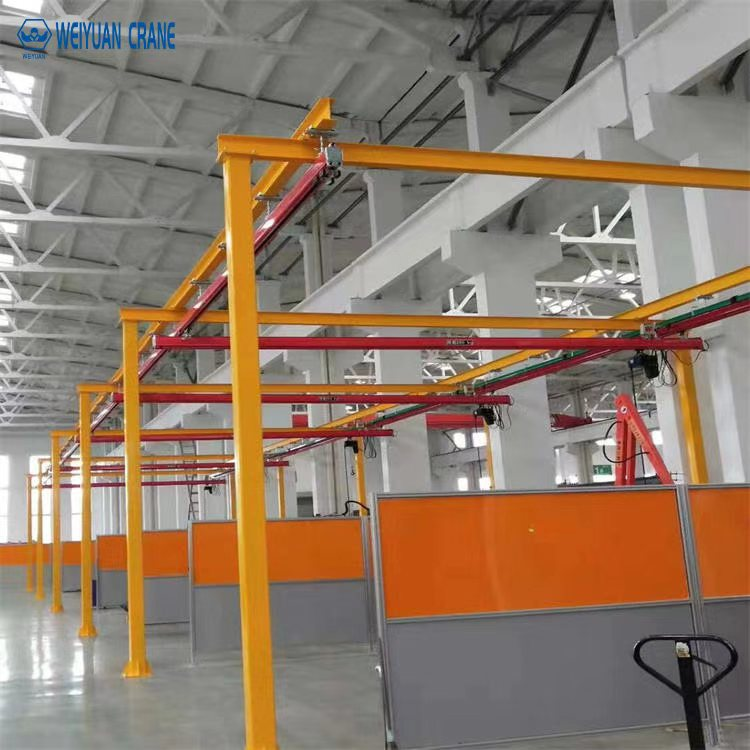
- Independent support frame — a purpose-built freestanding structure where the roof cannot carry the system or where mounting points don’t align with the building.
Getting the suspension and support right at design stage is critical, and the KBK installation guide covers the structural detail in depth.
Takeaway: Runway span, bridge length, and suspension spacing all follow the load rating and must align with the roof structure. Design them together, never stretch them to cut cost.
Duty Class and Component Selection
Duty class is the most under-appreciated line on a KBK specification, and the one that most determines how long the system lasts.
Capacity tells you how heavy a single lift can be. Duty class tells you how many lifts the system survives over its life. A KBK system on a high-frequency assembly line may cycle hundreds of times per station per shift, and the trolleys, hoist, and track must be classified for that intensity.
The risk runs both ways:
- Under-classify and the trolleys and hoist wear out early, forcing line-stopping replacements.
- Over-classify and you pay for durability the station never uses.
To specify it correctly, count the real lifts per hour, the typical load, and the daily running hours at the busiest station, then classify to that. A relentless automotive cell needs a materially higher duty class than an occasional-use maintenance station, even at the same load. This directly shapes which trolley, hoist, and track profile you select.
Takeaway: Specify duty class from your real cycle count at the busiest station — it decides component selection and how long the system runs before wear stops the line.
Environmental Factors
The environment can override every other decision, and it must be confirmed before the specification is finalized. Match the system to the real conditions.
IP Rating for Dust and Moisture
The hoist and electrics need an IP rating suited to the space:
- Clean, dry indoor: a standard rating is adequate.
- Dusty, humid, or washdown: step up the IP rating and add corrosion-resistant finishes.
Cleanroom and Pharmaceutical
Where particle control matters, the system must not contaminate the space. Specify stainless steel or a cleanroom-grade coating, sealed components, and hardware that won’t shed particles or corrode under sanitizing. KBK’s enclosed track resists debris well and cleans easily, which suits these settings.
Explosion-Proof for Hazardous Atmospheres
Where flammable gases, vapors, or combustible dust may be present — common in certain mining and processing areas — a standard hoist is an ignition risk. An explosion-proof or air hoist matched to the zone classification is a legal requirement. Confirm the area classification early, because it drives the entire specification and cannot be added on later.
Takeaway: Match IP rating, cleanroom materials, or explosion-proofing to the real site. A hazardous atmosphere overrides every other factor, so confirm classification before specifying anything.
A Practical Specification Framework
Here is a step-by-step way to reach a complete, comparable KBK specification. Work through the steps in order, and every quote you request answers the same question.
Step 1: Calculate True Capacity
Add the heaviest load, the hoist, the lifting device, the rigging, and a safety margin. Confirm the total sits comfortably within the KBK range at the busiest station.
Step 2: Map Coverage to Configuration
Trace the real work path. A straight line points to a monorail, a bounded area to a single-girder suspension crane, and a whole floor to a full grid.
Step 3: Plan the Track and Support Structure
Set runway spans, bridge length, and suspension point spacing to the profile rating, aligned with the roof structure. Decide between roof suspension and an independent support frame.
Step 4: Set the Duty Class
Count lifts per hour, typical load, and running hours at the busiest station, then classify the components to that intensity.
Step 5: Confirm the Environment
Match the IP rating, cleanroom materials, or explosion-proofing to the site, confirming any hazardous-area classification early.
Step 6: Plan for Growth
Leave the runway able to extend and add bridges later, so the next change is an addition, not a rebuild.
Takeaway: Capacity, coverage, track and structure, duty class, environment, then growth — six steps that turn a rough request into a tight, comparable specification.
KBK Specification Factors at a Glance
Use this table to organize the decision, then confirm each factor against your real operation.
| Specification factor | What it depends on | Common pitfall | How to get it right |
|---|---|---|---|
| Capacity | Load + all rigging + margin | Sizing on bare load | Add hoist, device, rigging, margin |
| Configuration | Coverage geometry | Forcing a grid on a linear path | Trace the real work path |
| Runway span | Profile rating + load | Stretching spans to save cost | Keep within rated limits |
| Bridge length | Coverage needed | Over-long bridge cutting capacity | Match length to real reach |
| Suspension spacing | Rating + roof structure | Points that miss roof members | Align with building steel |
| Duty class | Lifts per hour | Under-classifying a busy line | Specify from real cycle count |
| Environment | Site conditions | Ignoring dust, washdown, or hazard | Match IP, materials, ex-proofing |
How to Read the Table
Start at the top and work down: capacity and configuration frame the system, the track dimensions build it, and duty class and environment finish it. The pitfall column is where most specifications fail — check your own against each one before requesting quotes.
Takeaway: Each factor has a dependency and a common pitfall. Map both, and your specification becomes a checklist rather than a guess.
Common Specification Mistakes to Avoid
A handful of avoidable errors cause most of the regret in KBK projects. Knowing them upfront is the cheapest insurance in the process.
Mistake 1: Forgetting Rigging Weight
Sizing on the bare load ignores the hoist, spreader, and slings, which on a light KBK system can exceed 50% of the load.
Fix: Size on load plus all rigging plus a margin, at the heaviest station.
Mistake 2: Under-Classifying the Duty
A system correct for capacity but under-classified for a high-cycle line wears out early and stops production.
Fix: Specify the duty class from real lifts per hour, not a rough estimate.
Mistake 3: Ignoring the Roof Structure
A suspended system needs sound overhead steel at every suspension point, and buyers often assume the roof can carry it.
Fix: Verify the roof capacity early, or plan an independent support frame.
Mistake 4: Buying for Today’s Layout Only
Designing a rigid system for a line about to evolve wastes KBK’s biggest advantage — its modularity.
Fix: Leave the runway able to extend and add bridges as the floor changes.
Mistake 5: Treating KBK Like an Overhead Crane
Assuming the rating or the load path works like a heavy top-running crane leads to over-loading the suspended structure.
Fix: Respect the KBK rating as governing the whole suspended load path, and never overload to “upgrade” reach or capacity.
For keeping the specified system safe and reliable once installed, see the KBK safety and OSHA compliance guide and the KBK maintenance and inspection guide.
Takeaway: Most mistakes trace back to forgotten rigging, under-classified duty, an unverified roof, or a today-only layout. Close those gaps before you request quotes.
Frequently Asked Questions
Q: How do I calculate the required capacity for a KBK crane?
Start with your heaviest single load, then add everything hanging below the hook — the hoist (electric chain, air balancer, or vacuum lifter), the lifting device or spreader, and all slings and shackles — plus a safety margin. That total, not the bare load, is your required rated capacity. On a light KBK system that tops out around 2,000 kg, the hoist and rigging can be more than half the total, so forgetting them overloads the rating fast. Calculate it for the busiest and heaviest station, since one rating usually covers the whole run, and keep the total comfortably within the KBK range rather than at its edge.
Q: Why is a KBK load rating different from an overhead crane rating?
A KBK system is a suspended, modular, light-duty solution that hangs from the roof, while an overhead crane is a heavy top-running structure carried on runway beams and columns. KBK ratings reflect a lighter capacity band (typically up to ~2,000 kg), a suspension-based load path that transfers into the roof rather than the floor, and a design built for light, frequent, hand-guided motion. Crucially, the KBK rating governs the whole suspended load path — track profile, trolley, bridge length, and suspension spacing together — not just the hoist. That is why you cannot simply upgrade the hoist to lift more on an existing run.
Q: How do I choose between a monorail, suspension crane, and full grid?
Match the configuration to your coverage geometry. Choose a monorail for a straight, point-to-point transfer where the load never needs side-to-side reach — it is the simplest, lowest-cost layout. Choose a single-girder suspension crane for a bounded work cell that needs two-axis reach across a defined rectangle. Choose a full grid for a large multi-station floor where every point needs coverage with no dead spots, linking multiple bridges across shared runways. The practical test is to trace your real material flow onto each shape: a line, a rectangle, or a whole floor points you directly to the right configuration.
Q: What determines the track layout of a KBK system?
Four dimensions drive the layout, all tied to the load rating and the building. Runway span is the distance between suspension points along each track, kept within the profile’s rated limit for your load. Bridge length is the span the traveling bridge covers, matched to the coverage you genuinely need since over-long bridges cut capacity. Suspension point spacing follows the rating and must align with the roof’s structural members. And the support structure is either verified roof steel or a purpose-built independent frame. Design all four together, and never stretch spans or bridge length to save on hardware.
Q: How does duty class affect KBK component selection?
Duty class reflects how many lifts the system survives over its life, so it directly shapes which trolley, hoist, and track profile you select. A KBK system on a high-frequency assembly line may cycle hundreds of times per station per shift, demanding a materially higher duty class than an occasional-use station at the same load. Under-classifying causes the trolleys and hoist to wear out early and stop the line, while over-classifying means paying for durability you never use. Specify the class by counting the real lifts per hour, typical load, and daily running hours at the busiest station.
Q: What environmental factors matter when specifying a KBK crane?
Three factors can override the rest of the specification. First, IP rating: a clean, dry indoor bay needs only a standard rating, while dusty, humid, or washdown areas require a higher IP rating and corrosion protection. Second, cleanroom suitability: pharmaceutical and precision spaces need stainless or cleanroom-grade materials, sealed components, and non-shedding hardware. Third, explosion-proofing: where flammable gases, vapors, or combustible dust may be present, an explosion-proof or air hoist matched to the zone classification is a legal requirement. Confirm any hazardous-area classification early, because it drives the entire specification and cannot be retrofitted.
Q: Can I upgrade a KBK system’s capacity after installation?
Not by simply changing the hoist. The KBK rating governs the whole suspended load path — the track profile, trolley, bridge length, and suspension spacing were all sized to the original capacity. Increasing the load means re-engineering that load path and re-verifying the roof or support structure, which is effectively a new specification. This is why sizing correctly upfront, with a sensible margin for growth, matters so much. If your loads may increase, specify a higher capacity now rather than planning to upgrade later, because the suspended structure cannot safely carry more than it was designed for.
Q: How do I plan a KBK layout for future growth?
Design the runway so it can extend and accept additional bridges without a rebuild. Leave the support structure and runway ends able to carry an extension, size the initial capacity with headroom for likely load increases, and map the roof structure so future suspension points have somewhere to anchor. KBK’s modular, bolt-together design is built for exactly this kind of evolution, which is one of its biggest advantages over fixed systems. Remember, though, that every extension or added bridge is an alteration to a load-bearing structure, so it resets the installation and load-test baseline and must be re-verified before it carries work.