


Jib Crane Maintenance Guide: Inspection Checklists, Failure Points, and Compliance
Introduction
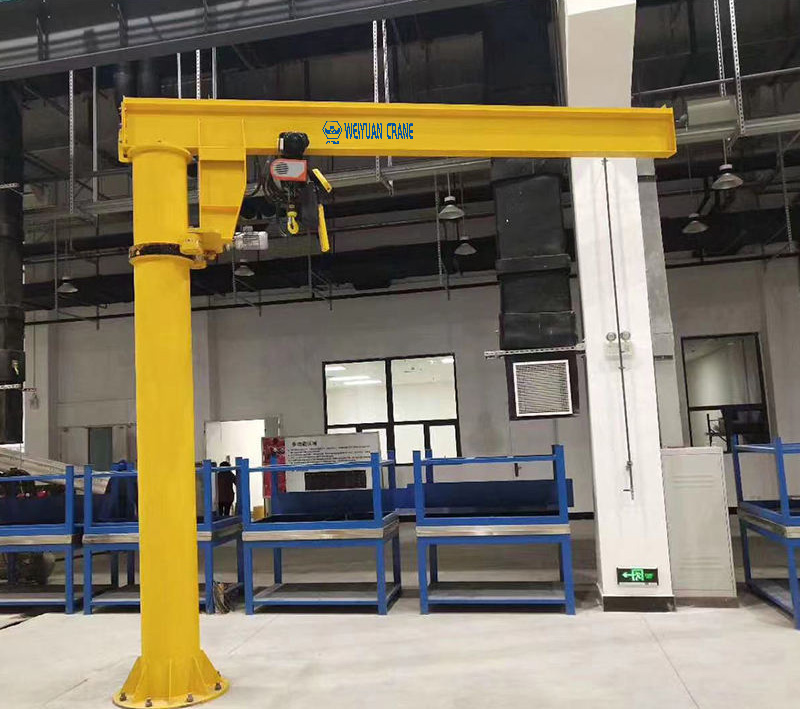
A jib crane looks like one of the simpler machines on your floor. One boom, one pivot, one hoist. That simplicity fools people into treating maintenance as optional — right up until the boom drops a load or the slewing bearing seizes mid-shift.
That gap between “simple” and “safe” is exactly where neglect gets expensive. A single jib crane failure can injure an operator standing directly in the swing path, stall a workstation, and trigger a compliance investigation that costs far more than years of routine inspection. And most failures do not arrive without warning. They build slowly — a loosening anchor bolt, a hairline crack at a boom weld, a wire rope quietly losing strands.
This guide gives you a practical maintenance framework built specifically for jib cranes. You will get a tiered inspection checklist split into daily, monthly, and annual intervals, a breakdown of the five failure points that cause most serious problems, a clear view of OSHA and ASME B30.12 compliance, and proven tips to stretch service life. Whether you run one jib crane at a machine tool or a dozen across a plant, this is the framework that keeps them safe, compliant, and productive.
Why Jib Crane Maintenance Pays for Itself
Maintenance is not a line item to cut. It is an investment that protects three things every facility owner cares about: safety, uptime, and capital.
Safety comes first. Jib cranes work at close quarters, often with an operator standing right beside the swinging boom. A cracked weld, a failed brake, or a loosened wall anchor can put a load directly onto a person. Regular inspection catches those risks before anyone gets hurt.
Uptime protects your output. Jib cranes usually serve a specific workstation or cell. When one goes down for emergency repair, that station stops — and the work backs up behind it. Planned maintenance moves repairs into scheduled windows instead of surprise breakdowns.
Capital preservation stretches the return. A well-built jib crane can serve 15 to 25 years. Neglect cuts that hard, forcing early replacement and unplanned capital spend. Consistent care protects the money you already invested.
There is also a compliance dimension. Regulators require documented inspection and maintenance. A failed audit or a recorded incident brings fines and liability that dwarf the cost of doing the work properly.
Takeaway: Maintenance is always cheaper than failure — and on a jib crane, failure often happens within arm’s reach of a person.
The Jib Crane Inspection Checklist
Effective inspection follows a tiered schedule. Quick, frequent checks catch obvious faults early. Deeper periodic inspections uncover wear that builds over weeks. Here is how to structure each level for a jib crane specifically.
Daily (Pre-Shift) Inspections
These are visual and functional checks the operator performs before each shift. They take minutes and prevent the most common causes of sudden failure.
- Boom rotation: Swing the boom through its full arc. Confirm smooth motion with no grinding, catching, or unusual resistance at the pivot.
- Hoist and trolley: Test hoist up and down and trolley travel along the boom for correct, smooth response.
- Emergency stop: Confirm the e-stop halts all motion instantly.
- Wire rope or chain: Look for kinks, broken wires, corrosion, twisting, or flattening. Check that it seats correctly in the drum or sprocket.
- Hook and latch: Inspect for deformation, cracks, or a damaged safety latch.
- Hoist brake: Verify the load holds without drift when suspended.
- Rotation stops: Confirm the boom’s rotation limit stops are in place and functional.
- General condition: Scan the boom, mast, and mounting point for visible cracks, leaks, loose bolts, or unusual noise.
Log every daily check. A simple pre-shift log builds a paper trail and flags recurring issues before they escalate.
Monthly (Periodic) Inspections
Monthly checks go deeper and should be done by trained maintenance staff. They target components that wear over weeks rather than hours.
- Pivot and slewing bearing: Check for play, excessive backlash, and correct lubrication. Listen for roughness through the rotation.
- Wire rope or chain detail: Measure diameter for reduction, count broken wires per lay length, and inspect end connections and terminations.
- Hook measurement: Check throat opening against the manufacturer’s spec for stretch.
- Hoist brake wear: Inspect pads or linings for thickness and confirm correct adjustment.
- Boom and mast: Inspect welds and connection points closely for early cracking or corrosion.
- Mounting integrity: Check wall bracket bolts or foundation anchor bolts for tightness and any sign of movement.
- Electrical: Examine the pendant, festoon cable or conductor bar, and control connections for wear or heat.
Annual (Comprehensive) Inspections
The annual inspection is a thorough, documented examination — often carried out or verified by a qualified third-party inspector. It combines everything above with deeper structural and mechanical assessment.
- Structural inspection: Examine the boom, mast, and support structure for cracks, corrosion, and deformation, with close attention to welds.
- Non-destructive testing (NDT): Use magnetic particle or dye-penetrant testing on critical welds and highly stressed members to find cracks the eye cannot see.
- Slewing bearing assessment: Measure bearing tilt and wear against the manufacturer’s tolerance limits.
- Anchor bolt verification: Check anchor bolt torque and inspect the concrete or steel around the mounting for cracking or spalling.
- Load testing: Where required, perform a rated or proof load test to verify capacity and brake holding.
- Documentation review: Confirm daily and monthly logs are complete and prior corrective actions were closed out.
Keep every annual report on file. This record is your main evidence of compliance and a valuable history for planning future work.
Takeaway: Match inspection depth to failure speed — check fast-wearing items daily, slow-developing structural risks annually.
The 5 Most Common Jib Crane Failure Points
Knowing where jib cranes typically fail lets you aim inspection effort where it matters. These five areas account for the majority of serious problems.
1. Pivot and Slewing Bearing
The pivot is what makes a jib crane a jib crane, and it carries every rotational and overturning force the boom generates. Over time, bearings develop play, roughness, and increased backlash from wear and poor lubrication. Left unchecked, a worn slewing bearing lets the boom tilt or bind, straining the mast and mounting.
Watch for grinding noise, uneven rotation, and visible tilt in the boom under load. Follow the manufacturer’s lubrication schedule religiously — dry or contaminated bearings fail far faster than the design ever intended.
2. Boom Welds and Structural Members
The boom carries the load out over its full reach, which puts constant bending and fatigue stress on its welds and connections. Cracks tend to start at weld toes and at the boom-to-mast joint, where stress concentrates. Because early cracks are often invisible, they grow quietly until the structure fails.
This is why NDT during annual inspections matters so much on high-cycle jib cranes. A structural failure at the boom is among the most dangerous outcomes possible, so treat any suspected crack as an immediate out-of-service condition.
3. Wall Brackets and Foundation Anchor Bolts
Unlike bridge or gantry cranes, many jib cranes hang their entire load on a wall bracket or a foundation anchor group. That mounting is safety-critical and often overlooked. Anchor bolts loosen under the cyclic overturning moment, and concrete around the base can crack or spall over time.
Check anchor bolt torque against the specification during periodic inspections, and inspect the surrounding concrete or steel for movement. A loosening anchor is a slow-motion failure — easy to catch early, catastrophic if ignored.
4. Wire Rope or Load Chain
The rope or chain carries the load directly, making it one of the most safety-critical components on the crane. Wire rope degrades through broken wires, corrosion, diameter reduction, kinking, and crushing. Load chain wears at the link contact points and stretches over time.
Replace rope or chain the moment it reaches the discard criteria in the standard — there is no safe margin for delay here. Also confirm it spools cleanly and seats properly in every sheave or sprocket.
5. Hoist Brakes
The hoist brake holds the load and controls lowering. Worn linings, poor adjustment, oil or moisture contamination, and weak springs all cut braking force. A brake that lets a suspended load drift is a clear signal to take the crane out of service until repaired.
Test brake holding under load during every daily check. On a jib crane, a dropped load frequently falls near the operator, so this component deserves close, consistent attention.
Takeaway: Most of these faults develop slowly — which is exactly why scheduled inspection stops them from becoming injuries.
OSHA and ASME B30.12 Compliance Standards
Jib crane maintenance is not just good practice. It is a legal requirement. Two frameworks govern the work in the United States, and procurement and facility managers need to understand both.
OSHA 29 CFR 1910.179
The Occupational Safety and Health Administration sets the legal baseline for workplace crane safety. OSHA 29 CFR 1910.179 covers overhead and gantry cranes in general industry and is widely applied to jib crane inspection, maintenance, and testing practices.
OSHA divides inspections into two categories that map neatly onto the checklist above:
- Frequent inspections: daily to monthly intervals
- Periodic inspections: one to twelve month intervals, based on activity and severity of service
Non-compliance risks citations, financial penalties, and forced shutdowns.
ASME B30.12
ASME B30.12 is the industry consensus standard written specifically for the construction, installation, inspection, testing, maintenance, and operation of jib cranes. This is the standard that speaks directly to your equipment — where OSHA sets the legal floor, B30.12 defines accepted engineering practice for jib cranes in particular.
Following B30.12 — including its inspection classifications, rope and chain discard criteria, and load test guidance — is the clearest way to demonstrate due diligence. When your equipment and inspection program align with B30.12, you have a defensible, standards-based answer for any audit.
For facilities operating internationally, additional standards such as ISO or regional equivalents may also apply. When in doubt, align your program with the strictest applicable standard.
Takeaway: OSHA sets the legal floor; ASME B30.12 is the jib-crane-specific playbook that keeps you above it.
Tips to Extend Jib Crane Service Life
Beyond meeting the minimum inspection requirements, these practices squeeze maximum value and longevity from your jib crane investment.
- Move from reactive to preventive maintenance. Schedule service by time and duty cycle, not by failure. Planned work is cheaper and far less disruptive than emergency repair.
- Lubricate the pivot on schedule. The slewing bearing is the heart of a jib crane. Follow the manufacturer’s greasing interval exactly — this single habit prevents a large share of premature failures.
- Recheck anchor bolts periodically. Cyclic loading loosens fasteners over time. Confirm torque against the specification, especially in the first months after installation.
- Train operators well. Smooth operation — no slamming the boom against its stops, no side-loading, no overloading — dramatically cuts stress on the pivot, welds, and mounting.
- Never exceed rated capacity. Overloading is a leading cause of accelerated wear and structural fatigue. Clear capacity markings and load limiters enforce discipline.
- Fix small issues immediately. A minor fault caught early is cheap. Left alone, it compounds into a major failure. Close out every flagged item promptly.
- Keep thorough records. A complete maintenance history supports compliance, informs replacement planning, and protects resale value.
Takeaway: Longevity is not luck. On a jib crane, it comes down to a well-greased pivot, tight anchors, and disciplined operation.
Frequently Asked Questions
Q: How often should a jib crane be inspected?
Jib cranes need a tiered schedule: daily pre-shift checks by the operator, monthly periodic inspections by trained maintenance staff, and a comprehensive annual inspection, often verified by a qualified third party. Cranes in heavy or high-cycle service may need more frequent periodic checks. This structure aligns with both OSHA 1910.179 and ASME B30.12.
Q: What are the most common jib crane failure points?
The five most frequent are the pivot or slewing bearing (play and wear), boom welds (fatigue cracking), wall brackets and foundation anchor bolts (loosening and concrete cracking), wire rope or chain (broken wires and stretch), and hoist brakes (worn or contaminated linings). Most develop gradually, which is exactly why regular inspection catches them before failure.
Q: What safety standards apply to jib crane maintenance in the US?
OSHA 29 CFR 1910.179 sets the legal requirements for cranes in general industry, covering inspection, maintenance, and testing. ASME B30.12 is the consensus standard written specifically for jib cranes and defines the detailed engineering best practice. OSHA sets the legal floor while ASME B30.12 provides the jib-crane-specific guidance, and the two are used together.
Q: Why are the anchor bolts so important on a jib crane?
Many jib cranes transfer their entire load and overturning moment into a single wall bracket or foundation anchor group. If those anchors loosen or the surrounding concrete cracks, the whole crane’s stability is compromised. Because the failure develops slowly under cyclic loading, checking anchor bolt torque during periodic inspections is a small task that prevents a catastrophic outcome.
Q: When should a wire rope or load chain be replaced?
Replace it as soon as it reaches the discard criteria in the applicable standard — a set number of broken wires per lay length, measurable diameter reduction, corrosion, kinking, crushing, or chain stretch beyond the limit. Because the rope or chain carries the load directly, there is no safe margin for postponing replacement once these thresholds are reached.
Q: Can we perform jib crane inspections in-house or do we need a third party?
Daily and monthly inspections are usually performed in-house by trained operators and maintenance staff. The comprehensive annual inspection — especially structural assessment, NDT of boom welds, slewing bearing measurement, and load testing — is generally best carried out or verified by a qualified third-party inspector to ensure objectivity and compliance.