


Jib Crane Maintenance, Inspection & Compliance
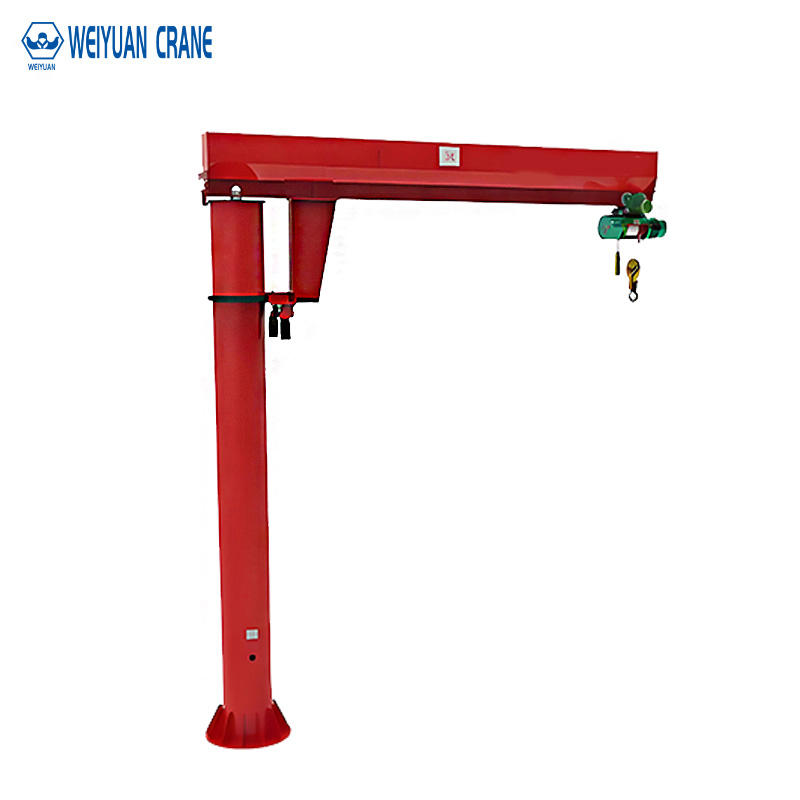
A plant safety officer once told me his jib crane “basically maintained itself.” It had run for four years without a single logged inspection. Then, mid-lift, the boom stopped swinging. The slewing bearing had seized — years of grit and no grease had welded it solid. The repair meant pulling the entire boom, replacing the bearing, and shutting the cell for six days. The bearing cost a few hundred dollars. The downtime cost tens of thousands.
The crane didn’t fail suddenly. It had been telling him for months — a stiffer swing here, a groan there, grease points nobody had touched since installation. Nobody was listening, because nobody was inspecting.
That’s the pattern behind almost every serious jib crane failure I’ve seen. The machine degrades slowly and visibly, and the operations that catch the signals keep their cranes running the full 15-to-20-year service life. The ones that treat a jib as “install and forget” pay for it — in a seized slewing mechanism, a dropped load, or a crane out of service the exact week production can’t spare it.
This is the final article in our three-part jib crane series. Part 1 covered workstation selection — geometry, reach, mounting, and duty class. Part 2 covered outdoor and industrial specification — IP ratings, corrosion, and foundations. Here we close the loop on the part that decides whether that upfront work pays off: keeping the crane reliable, compliant, and safe across its whole life.
What you’ll take away:
- A practical inspection schedule — daily to annual — you can hand straight to your team
- What ASME B30.2 and OSHA 1910.179 actually require of a jib crane
- Clear rejection criteria for wire rope, chain, and the slewing mechanism
- Safety device testing, load test rules, a repair-vs-replace framework, and a 2026 cost reference
Part 1: The Inspection Schedule — Daily to Annual
The single best predictor of jib crane uptime isn’t the brand on the boom. It’s whether an inspection schedule actually runs on time. Not an elaborate one — a consistent one. The best programs layer frequent, shallow checks over rarer, deeper inspections, so problems surface while they’re still cheap.
Here’s a practical structure you can adapt to your crane’s duty class. Higher duty (3m/M6 from Part 1) tightens every interval; light-duty cranes can stretch them.
Daily / Pre-Shift Checks
An operator handles these in a few minutes before the first lift. No tools — just eyes, ears, and a checklist:
- Test the pendant controls and emergency stop before lifting
- Confirm the hoist brake holds by lifting a load slightly and pausing
- Check the boom swings freely through its full arc without binding or grinding
- Visually inspect the wire rope or chain for kinks, broken wires, or bird-caging
- Confirm the hook and safety latch are intact and the latch springs closed
Log the result — even a five-second “all normal” entry. That log is your compliance trail in an audit and your first evidence if something goes wrong.
Weekly Checks
A technician spends 20 to 40 minutes on a closer pass:
- Inspect the full length of wire rope or chain for wear, corrosion, and diameter loss
- Listen to the slewing motion for roughness or a change in effort
- Check for oil weeping around the hoist and any gearbox
- Function-test the overload protection
- Inspect the pendant cable or festoon system for wear and strain
Monthly Checks
A deeper mechanical review, usually 1 to 3 hours:
- Grease the slewing bearing and all lubrication points per the manufacturer’s schedule
- Measure wire rope diameter and compare against the rejection threshold
- Inspect hoist brake lining thickness and adjustment
- Check the mast anchor bolts and boom connection bolts for looseness (ties back to Part 2’s mounting work)
- Test the rotation stops and confirm they hold the boom at their set points
Annual Comprehensive Inspection
The thorough examination — often by an external qualified inspector, with a written report:
- Full structural inspection of the mast, boom, and bracket or foundation connection
- Non-destructive examination (NDT) of critical welds where required
- Complete wire rope or chain assessment against rejection criteria
- Slewing bearing wear and end-float measurement
- Load test where regulation or a major repair requires it (see Part 6)
The takeaway: daily checks catch the obvious, weekly and monthly checks catch the developing, and the annual inspection catches the hidden — the seized bearing that started as a stiff swing months earlier.
Part 2: What ASME B30.2 and OSHA 1910.179 Require
Two documents govern crane inspection in most markets that reference US standards, and both apply to jib cranes. Knowing what they demand protects you legally, keeps your insurance valid, and — bluntly — keeps people safe.
OSHA 1910.179 is the federal regulation for overhead and gantry cranes in general industry, and its inspection and maintenance principles extend to jib cranes as powered lifting equipment. It’s the law, not a guideline. It sets operator responsibilities, inspection requirements, and load-test rules, and non-compliance is a citable violation.
ASME B30.2 is the consensus safety standard OSHA leans on for technical detail — inspection frequencies, component rejection criteria, and testing methods. For jib cranes specifically, many manufacturers also reference ASME B30.11 and B30.16 for the monorail and hoist elements. Together they define two inspection categories that map cleanly onto Part 1:
- Frequent inspections — daily to monthly, covering what operators and technicians check routinely
- Periodic inspections — one to twelve months, more thorough, documented, and covering structure, wear components, and safety devices
Here’s the connection procurement teams miss: the duty class you specified back in Part 1 directly sets the inspection workload.
| Service intensity | FEM / ISO Class | Frequent inspection | Periodic inspection |
|---|---|---|---|
| Occasional / maintenance | 1Bm / M3 | Daily to monthly | Yearly |
| Light assembly | 1Am / M4 | Daily to monthly | 6–12 months |
| Steady production | 2m / M5 | Daily to weekly | 3–6 months |
| Heavy / multi-shift | 3m / M6 | Each shift to weekly | 1–3 months |
The ownership implication is direct: a higher-duty jib costs more to own, not just to buy. Factor the recurring inspection burden into total cost, and you’ll see why a correctly matched duty class from Part 1 pays off for years.
Part 3: Wire Rope and Chain — Rejection Criteria
The wire rope or load chain is the one component whose failure drops the load, so it earns the strictest scrutiny. The good news: it degrades visibly and predictably. A disciplined routine catches trouble with room to spare.
Wire Rope Rejection Criteria (ASME B30.2)
Remove and replace the rope when you find any of these:
- Broken wires — a defined number of randomly distributed broken wires in one rope lay, or several concentrated in a single strand
- Diameter reduction from wear beyond the allowed percentage of nominal; severe localized wear over one-third of the outer wire diameter is an immediate reject
- Corrosion — visible pitting or rust, with internal corrosion especially dangerous because it hides
- Structural distortion — kinking, crushing, bird-caging, or core protrusion
- Heat damage — discoloration from heat or an electric arc
Measure rope diameter monthly with a caliper across the crowns, and log it. A steady decline tells you when replacement is coming, so you order on your schedule instead of during a panic shutdown.
Chain Rejection Criteria
Most jib cranes run a chain hoist, so this is the common case. Replace the load chain when you find:
- Stretch beyond the manufacturer’s limit, measured over a defined number of links — a sign of overload or fatigue
- Wear reducing link material below the minimum diameter
- Cracks, nicks, or gouges on any link surface
- Twisted, bent, or seized links that won’t articulate freely
The procurement angle: keep the correct replacement rope or chain in stock, matched to your specific hoist. The cost of holding the part is trivial next to the downtime of waiting for a specified chain during an unplanned failure.
Part 4: The Slewing Mechanism and Boom — The Jib-Specific Failure Point
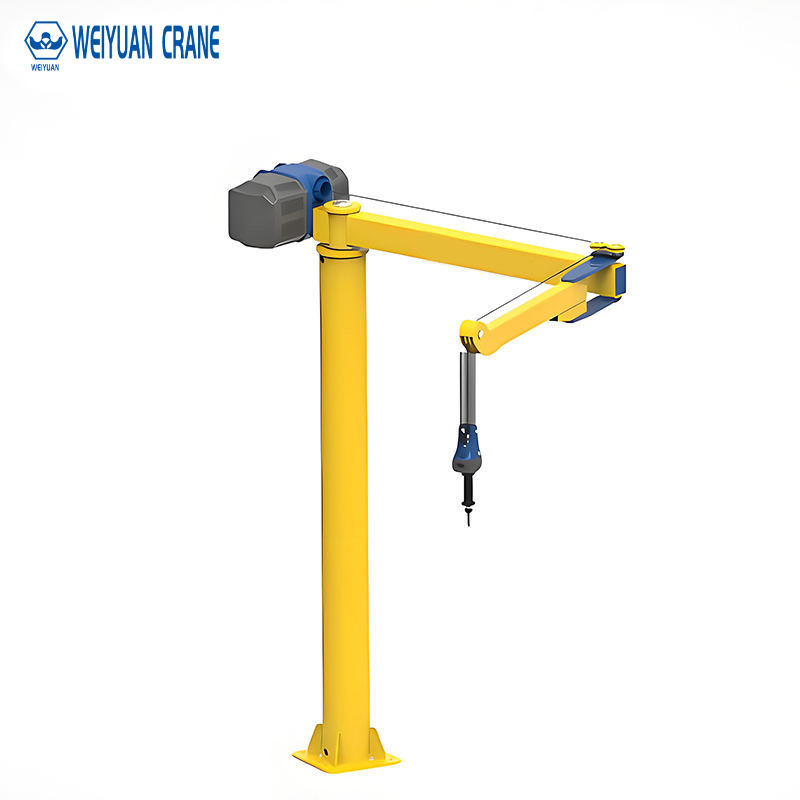
Here’s where jib maintenance differs from any overhead or gantry crane: the slewing mechanism. The boom rotates about the mast on a slewing bearing (or a set of thrust and radial bearings), and this rotation is where jib cranes fail in ways other cranes never do. The seized bearing in our introduction is the classic case.
Why the Slewing Bearing Needs Attention
The slewing bearing carries the full overturning moment every time the boom holds a load — the same push-pull force Part 2 described. It rotates slowly, under high load, often in a dusty or wet environment. Slow, heavily loaded bearings are exactly the kind that fail from poor lubrication, because grease doesn’t redistribute the way it does in a fast-spinning bearing. Miss the grease schedule and grit works in, the bearing roughens, and eventually it seizes.
Service the slewing mechanism by:
- Greasing on schedule — this is the single most important jib-specific maintenance task, and the most commonly skipped
- Checking rotation effort — a boom that’s getting harder to swing by hand is warning you
- Measuring bearing end-float and play — increasing movement signals wear progressing toward failure
- Inspecting the slewing drive (on motorized jibs) — gear wear, motor current, and brake function
Boom and Mast Structural Checks
The boom and mast carry cyclic bending every lift. Inspect for:
- Cracks at welds, especially where the boom meets the mast and at bracket connections
- Deflection or permanent set in the boom — a boom that no longer sits level under no load has yielded
- Loose or elongated bolt holes at the boom-to-mast and bracket connections
- Coating breakdown exposing bare steel to corrosion (ties back to Part 2)
Here’s what to remember: on a jib crane, the slewing bearing is the component that turns a skipped grease schedule into a six-day shutdown. Put it at the top of your monthly checklist.
Part 5: Safety Devices — Test Them, Don’t Just Trust Them
Safety devices fail silently. A limit switch that quit working doesn’t announce itself until the day it was supposed to stop an over-travel and didn’t. The rule is simple: test every safety device on a schedule — don’t assume it works.
| Device | What it protects against | Test frequency |
|---|---|---|
| Emergency stop | Loss of control in any situation | Daily |
| Upper/lower hoist limit switch | Hoist over-travel and rope damage | Monthly, minimum |
| Overload protection | Lifting beyond rated capacity | Monthly |
| Rotation stops | Boom swinging into an aisle, wall, or next cell | Monthly |
| Hook safety latch | Slings jumping the hook | Daily visual |
Three field notes that matter for jib cranes specifically. Test the upper limit switch without a load to verify it cuts hoist power before over-travel. Confirm overload protection actually engages at its set point — a device that’s drifted out of calibration protects nothing. And check the rotation stops hold the boom firmly at their set angle, because a failed stop on a 360° jib can swing a suspended load straight into a walkway or the neighbouring workstation.
Document every test with date and result. That record is both your compliance evidence and your early warning that a device is drifting out of spec.
Part 6: Load Test Requirements
A load test proves the crane can safely handle its rated capacity — and it’s required at specific points, not just when you feel like it. Under ASME B30.2 and OSHA guidance, a proof load test applies:
- Before first use of a new jib crane
- After any major repair or modification to a load-bearing component — a replaced boom, a rebuilt slewing mechanism, a repaired weld
- After reinstallation if the crane is moved to a new mounting or foundation
The standard proof load is 125% of rated capacity, held and moved through the crane’s motions — lift, swing through the full arc, and lower — while an inspector watches for deflection, drift, or any abnormal behavior. On a jib, the swing under load matters as much as the lift: the test has to confirm the mast, foundation or brackets, and slewing bearing all handle the overturning moment at 125% without movement or distress.
The procurement point: budget the load test into any new installation or major repair, and require documented results. A crane returned to service after a boom repair without a load test is a liability with no paper trail — and a fast way to fail an audit.
Part 7: Repair or Replace — Making the Call on Evidence
Every long-lived jib crane eventually forces the repair-versus-replace question. The decision gets far easier when you split it by component instead of treating the crane as one all-or-nothing asset.
Repair or Refurbish the Subsystem
When the mast and boom are structurally sound, repair or replace the worn subsystem — not the whole crane. The hoist, wire rope or chain, slewing bearing, brake, and controls are all serviceable or replaceable. If the mast, boom, and connection pass structural inspection and NDT, refurbishing the mechanical parts around a sound structure is almost always cheaper than a new crane — and it skips the lead time of specifying and installing a replacement (Parts 1 and 2).
A seized slewing bearing, for example, is a repair — not a reason to scrap the crane, provided the boom and mast are intact.
Replace the Whole Crane When:
- The mast or boom shows cracks beyond acceptance criteria, or permanent deflection from overload
- The foundation or bracket connection has failed and can’t be economically restored
- Cumulative repair costs start approaching the value of a new, correctly specified crane
- Your operation has outgrown the crane’s capacity, reach, or duty class
Here’s the discipline that makes this decision defensible to management and to a regulator: keep good records. A complete inspection and repair history — the paper trail this whole series builds — lets you make the call on evidence rather than guesswork. Operations that kept disciplined records decide with confidence. The ones that didn’t are gambling with a capital asset.
Part 8: 2026 Cost Reference for Maintenance and Inspection
Use these as planning figures to build a realistic maintenance budget. Actual costs vary with crane size, duty class, location, and whether work runs in-house or contracted.
| Program element | Scope | 2026 planning range |
|---|---|---|
| Annual thorough inspection | External qualified inspector + written report | $800 – $3,500 |
| NDT of critical welds | Certified MT/PT on boom, mast, and connections | $1,500 – $6,000 |
| Wire rope replacement | Rope + labor | $600 – $4,000 |
| Load chain replacement | Chain + labor | $400 – $2,500 |
| Slewing bearing replacement | Bearing + boom removal + labor | $2,500 – $12,000 |
| Hoist brake service / reline | Lining, adjustment, hold test | $600 – $3,000 |
| 125% load test | Test weights, rigging, certification | $1,500 – $6,000 |
| Preventive maintenance contract | Scheduled visits, greasing, adjustments | $2,000 – $10,000 / year |
| Operator training | Certification + periodic re-assessment | $400 – $1,500 per operator |
Two budget realities for procurement teams:
- A preventive maintenance contract almost always costs less than reactive repair. Scheduled greasing alone would have prevented the seized slewing bearing that opened this article — a few visits a year against a six-day shutdown and a five-figure repair. Planned spend is predictable; emergency spend never is.
- Deferred maintenance scales sharply on jib cranes. A monthly grease of the slewing bearing sits at the bottom of the cost range. Ignoring it until the bearing seizes puts you at the top — bearing, boom removal, labor, and lost production combined.
Procurement tip: when you scope a maintenance contract, confirm exactly what’s included — inspections, greasing, consumables, callout response time, and parts. A cheap contract that excludes wear parts and emergency response isn’t a saving; it just moves the cost to your worst possible moment. Weigh response time as heavily as price. Uptime is what you’re actually buying.
Frequently Asked Questions
Q: How often does a jib crane legally need inspection?
A: Under OSHA 1910.179 and ASME B30.2, inspections split into frequent (daily to monthly) and periodic (one to twelve months), with the exact frequency set by the crane’s duty class. A heavy, multi-shift jib needs more frequent periodic inspection than an occasional-use one. At minimum, plan on operator daily checks, a documented monthly inspection, and a thorough annual inspection by a qualified person with a written report. Confirm the rules for your jurisdiction and facility type, as local requirements can be stricter.
Q: What’s the most important maintenance task specific to jib cranes?
A: Greasing the slewing bearing on schedule. This is the jib-specific task most often skipped and most likely to cause a major failure. The bearing carries the full overturning moment, rotates slowly under high load, and often sits in a dusty or wet environment — conditions that punish poor lubrication. A missed grease schedule lets grit work in until the bearing roughens and seizes, turning a routine task into a boom-removal repair and days of downtime. Put it at the top of your monthly checklist.
Q: When must a jib crane be load tested?
A: At three points: before first use of a new crane, after any major repair or modification to a load-bearing component (a replaced boom, rebuilt slewing mechanism, or repaired structural weld), and after reinstallation at a new mounting or foundation. The standard proof load is 125% of rated capacity, lifted and swung through the full arc while an inspector checks for deflection, drift, or distress. On a jib, the test must confirm the mast, connection, and slewing bearing all handle the overturning moment at 125% — and the results must be documented.
Q: How do I decide whether to repair or replace a jib crane?
A: It comes down to the mast and boom. If they pass structural inspection and NDT, you can refurbish the mechanical parts — hoist, rope or chain, slewing bearing, brake, controls — around a sound structure for far less than a new crane, and avoid the replacement lead time. A seized slewing bearing on an intact boom is a repair, not a write-off. Replace the whole crane only when the mast or boom is cracked or permanently deflected, the connection has failed, cumulative repair costs approach a new crane’s value, or you’ve outgrown the capacity or reach. A complete inspection history lets you decide on evidence.
Q: Which safety devices must I test, and how often?
A: Test the emergency stop and check the hook safety latch daily. Test the hoist limit switches, overload protection, and — crucially for jibs — the rotation stops at least monthly, under load where applicable. Rotation stops matter because a failed stop on a 360° jib can swing a suspended load into an aisle, wall, or neighbouring cell. Safety devices fail silently, so testing — not trusting — is the rule. Document every test with date and result; that record is both your compliance evidence and your early warning that a device is drifting out of spec.