


Jib Crane vs Overhead Crane: How to Choose the Right Lifting Solution for Your Facility
Introduction
Two facilities lift the exact same 2-tonne load, dozens of times a shift. One installs a jib crane and gets everything it needs for a fraction of the cost. The other installs an overhead crane and gains coverage the jib could never deliver. Same load — completely different right answer.
That is the trap procurement managers fall into. The decision between a jib crane and an overhead crane is rarely about capacity alone. It comes down to how much of your floor you need to cover, how high you can lift, what your building can carry, and how hard the crane will work. Get it right and you buy exactly the lifting you need. Get it wrong and you either overpay for coverage you never use, or starve a busy bay of the reach it demands.
This guide compares the two head to head, from the point of view of the person writing the specification. You will learn the structural differences, how capacity and span compare, workstation versus full-bay coverage, headroom and building requirements, real cost over the crane’s life, and which duty cycles suit each. By the end, you will know exactly which crane fits your facility — and why.
This is article 3 of 3 in the Weiyuan Crane jib crane series. Where article 1 covered safety and OSHA compliance and article 2 covered installation, this one helps you choose between a jib crane and an overhead crane in the first place.
The Core Structural Difference
Everything else in this comparison flows from one basic difference in how the two cranes are built and how they move a load.
How a Jib Crane Works
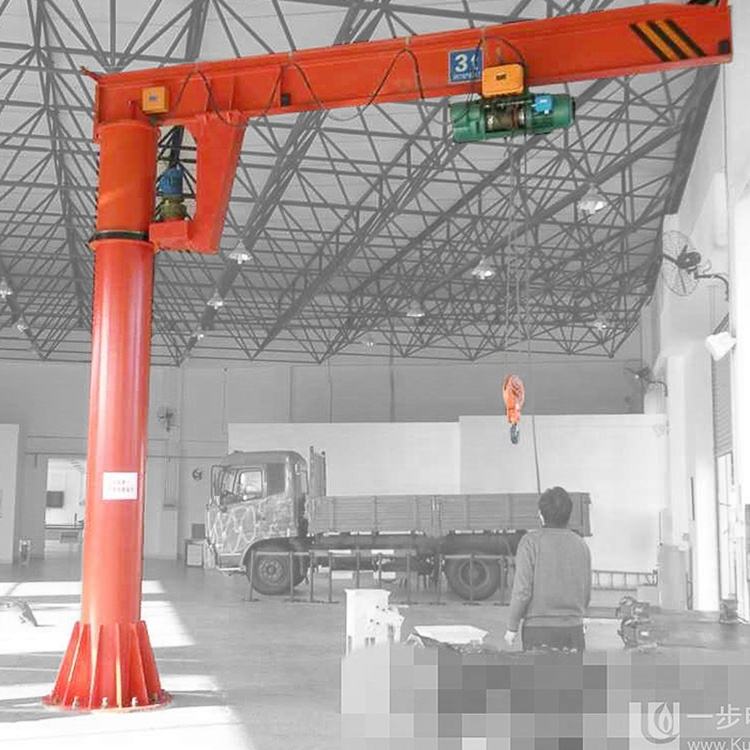
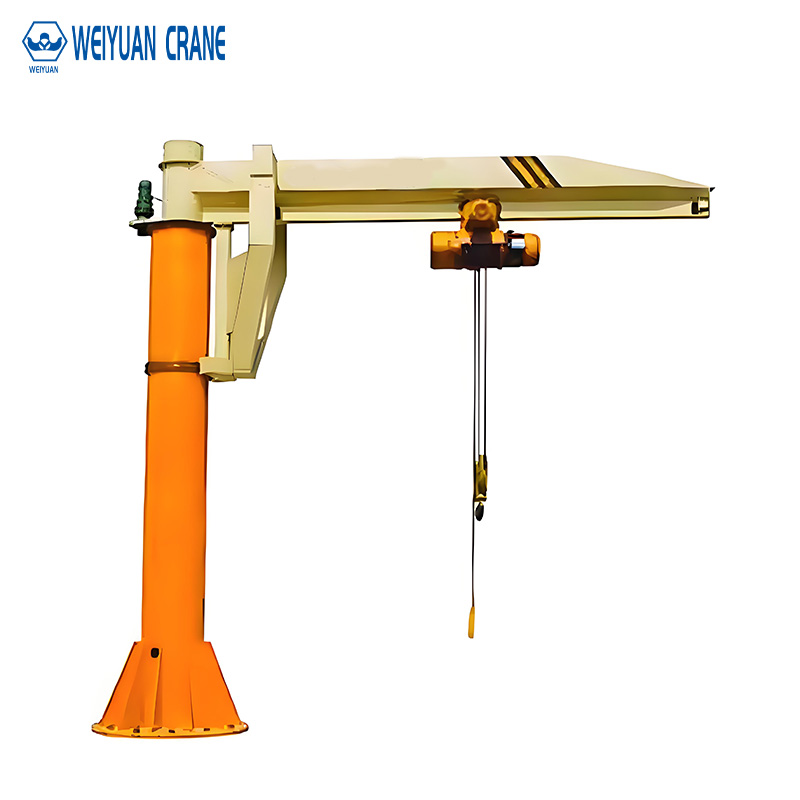
A jib crane is a single horizontal boom that rotates around a fixed point — a column, a wall bracket, or a mast. A hoist rides a trolley along the boom, and the boom swings through an arc. The load moves in and out along the boom, and around in a circle. That is the whole range of motion: a pie slice of coverage centered on the mount.
The entire load, plus the leverage of the boom, passes through that single support. Simple, compact, and built to serve one spot.
How an Overhead Crane Works
An overhead crane uses a bridge that spans two elevated runways. The hoist and trolley traverse the bridge side to side, while the bridge travels along the runways end to end. The load can reach almost any point within a rectangle — the full length and width the runways cover.
That rectangular coverage is the defining advantage of an overhead crane, and it is exactly what a jib crane cannot do.
Takeaway: a jib crane covers a circular area around one point; an overhead crane covers a rectangular area across a whole bay. This single difference drives every other decision below.
Capacity and Span Comparison
Capacity and reach are usually the first numbers a buyer looks at, and the two cranes sit in genuinely different ranges.
Jib Crane Capacity and Reach
Jib cranes are built for light to moderate loads over short reaches. Typical ranges:
- Capacity: commonly 0.25 to 5 tonnes, with heavier models up to around 10 tonnes.
- Reach (boom length): commonly 2 to 8 metres.
Because the load hangs at the end of a boom, reach and capacity trade off against each other — a longer boom with the same load creates a much larger overturning moment on the mount. Jib cranes shine where loads are modest and the work happens within a defined radius.
Overhead Crane Capacity and Span
Overhead cranes cover a far wider range, from light-duty single girder units to massive process cranes:
- Capacity: from around 1 tonne to several hundred tonnes.
- Span: commonly 10 to 30 metres, and beyond with the right girder design.
If your loads are heavy, your bay is wide, or both, the overhead crane is often the only realistic option.
Where They Overlap
The two cross over in the light-duty band — roughly 1 to 10 tonnes over short distances. This is exactly where the decision gets interesting, because both cranes can do the job. Here, the choice turns not on capacity but on coverage, headroom, cost, and duty cycle.
Takeaway: jib cranes handle light-to-moderate loads over short reaches; overhead cranes cover everything from light duty to heavy, across wide bays. They overlap in the 1–10 tonne short-reach band, where other factors decide.
Coverage: Workstation vs Full-Bay
This is the heart of the comparison, and often the fastest way to reach the right answer.
Jib Crane: Focused Workstation Coverage
A jib crane serves one point exceptionally well. It rotates over a single machine, assembly cell, or loading spot, moving loads within its arc quickly and ergonomically. Operators guide loads by hand with minimal effort, cycle after cycle.
Where the work stays put — feeding one machine, loading one station, serving one bay door — a jib crane delivers precise, repetitive lifting without paying for coverage you do not use. Multiple jib cranes can also serve several stations independently, each doing its own job.
Overhead Crane: Whole-Bay Coverage
An overhead crane reaches every point across an entire bay. It moves loads from any position to any other, serves multiple machines and stations from one system, and handles material flow across the whole floor.
Where work moves across a large area — between machines spread along a line, from receiving to storage to production — an overhead crane provides coverage no jib can match.
The Decision in Practice
Ask one question: does the lifting happen at fixed points, or across an area?
- Fixed points (one machine, one cell, one dock) → jib crane
- Across an area (whole bay, multiple stations, material flow) → overhead crane
Takeaway: coverage is usually the deciding factor. Jib cranes own the workstation; overhead cranes own the bay. Match the crane to how your work actually flows.
Headroom and Lift Height
How much usable lift you get from a fixed building height differs sharply between the two.
Jib Crane Headroom
A jib crane’s boom mounts below the roof and the hoist hangs beneath the boom, so the crane occupies vertical space that reduces your available hook height. In a low building, that loss can matter. Wall-mounted and articulating designs help, but a jib crane rarely maximizes lift height in a tight space.
Overhead Crane Headroom
Overhead cranes offer more flexibility here. A top-running double girder design lifts the hook close to the underside of the roof, recovering hook height. Low-headroom hoists and trolleys tighten the gap further. Where every centimetre of lift counts, an overhead crane — correctly configured — usually delivers more usable hook height than a jib crane of similar capacity.
So what? If your building clear height is fixed and low, and you need maximum lift, that constraint alone can point you toward an overhead crane.
Takeaway: both cranes consume some headroom, but overhead cranes offer more configuration options to recover hook height in tight buildings.
Building and Mounting Requirements
Each crane loads your building differently, and your existing structure often decides what is even possible.
What a Jib Crane Demands
- Floor-mounted (freestanding): needs a dedicated reinforced concrete foundation sized for the overturning moment. No building support required — ideal where the structure cannot carry a crane.
- Wall-mounted: transfers the load into a wall or column, which must be verified for high pull-out forces.
- Mast-mounted: shares the load between a floor base and a top support point.
A freestanding jib crane’s independence from the building is a real advantage in older or lightly built facilities.
What an Overhead Crane Demands
- Top-running: loads its runway beams, columns, and foundations. Needs a column-supported runway engineered for the crane.
- Underhung: hangs from the roof structure, which must carry the crane’s dead weight plus rated load.
An overhead crane imposes far larger, distributed loads on the building than a single jib mount. Where the existing structure cannot carry them, you reinforce it or add a freestanding support system — and that cost belongs in the decision.
Takeaway: a jib crane can often stand on its own foundation without touching the building; an overhead crane demands a runway or roof structure engineered for its loads. Check what your building can carry before you choose.
Cost: Purchase Price and Total Cost of Ownership
Cost is where the two cranes separate most clearly — and where the sticker price misleads the most.
Purchase and Installation
A jib crane is significantly cheaper to buy and install than an overhead crane of comparable capacity. It is a single boom on one mount, with a smaller foundation and a faster installation. An overhead crane involves two runways, a bridge, columns or roof support, and a longer, more complex installation.
For light-duty lifting at fixed points, the jib crane wins decisively on upfront cost.
Total Cost of Ownership
Purchase price is only the start. Over 15 to 20 years, consider:
- Energy: overhead cranes with larger motors use more, though right-sized drives narrow the gap.
- Maintenance and spares: an overhead crane has more components — two runways, more wheels, more controls — and therefore more to maintain.
- Coverage value: an overhead crane serves work a jib cannot. If you need that coverage, its higher cost buys capability, not waste.
- Downtime: the biggest hidden cost for either crane. A well-specified crane that rarely fails is worth far more than a cheap one that stops production.
The Real Comparison
Do not compare “which crane is cheaper.” Compare “which crane delivers the coverage and duty I need at the lowest cost of ownership.” If a jib crane meets the need, it is almost always cheaper to own. If you need bay-wide coverage or heavy capacity, the overhead crane’s higher cost is the price of capability you cannot get any other way.
Takeaway: jib cranes cost far less to buy and own for fixed-point light duty. Overhead cranes cost more — but that cost buys coverage and capacity a jib simply cannot provide.
Duty Cycle Suitability
How hard and how often each crane works shapes both the specification and the choice.
Jib Crane Duty
Jib cranes suit light-to-moderate, high-cycle work at a single station — repetitive ergonomic lifts guided by hand, all shift. Sized correctly for the duty, they deliver reliable, low-effort lifting exactly where it repeats. They are less suited to heavy, continuous, area-wide production.
Overhead Crane Duty
Overhead cranes span the full duty range, from occasional light lifting (CMAA Class A–B) to severe continuous service (Class E–F) in steel plants and foundries. A double girder crane built to a high duty class handles heavy, constant cycling across a wide bay — work far beyond any jib crane’s design.
So what? Match the crane to your real cycle count and load. A jib crane cycling light loads at one spot is ideal; a bay running heavy loads all shift needs an overhead crane built to the right duty class.
Takeaway: jib cranes excel at high-cycle light lifting at a fixed point; overhead cranes cover the whole duty spectrum, including heavy continuous service across a bay.
Ideal Use Cases for Each
Pulling it together, here is where each crane clearly wins.
Choose a Jib Crane When:
- Lifting happens at one machine, cell, or loading point.
- Loads are light to moderate (under ~10 tonnes) over a short reach.
- You need ergonomic, repetitive lifting at a workstation.
- The budget is tight and coverage needs are focused.
- The building cannot easily support a full runway (a freestanding jib stands alone).
- You want to supplement an overhead crane by handling detailed work at individual stations.
Choose an Overhead Crane When:
- Lifting must cover a whole bay or move material across the floor.
- Loads are heavy, the span is wide, or both.
- You need maximum hook height in a fixed building (top-running double girder).
- The work involves heavy, continuous, area-wide production.
- Multiple machines or stations must be served from one system.
A Common Hybrid
Many facilities use both. An overhead crane handles bay-wide material flow and heavy lifts, while jib cranes at individual stations handle fast, repetitive detail work — freeing the overhead crane for the jobs only it can do. If your operation has both patterns, the two crane types complement rather than compete.
Takeaway: jib cranes win at fixed-point light duty; overhead cranes win at bay-wide and heavy duty. Many facilities benefit from both working together.
Frequently Asked Questions
Q: What is the main difference between a jib crane and an overhead crane?
A jib crane is a single rotating boom that covers a circular area around one fixed mount — a column, wall, or mast — and suits light-to-moderate lifting at a single workstation. An overhead crane uses a bridge running on two elevated runways to cover a full rectangular bay, handling everything from light to very heavy loads across a wide area. The core difference is coverage: a jib serves one point, while an overhead crane serves a whole bay.
Q: Which is cheaper, a jib crane or an overhead crane?
For comparable light-duty capacity, a jib crane is significantly cheaper to buy, install, and own. It is a single boom on one mount, with a smaller foundation and faster installation than an overhead crane’s twin runways, bridge, and supporting structure. However, an overhead crane delivers bay-wide coverage and heavy capacity a jib cannot, so if you need that capability, its higher cost buys function rather than waste. Compare on total cost of ownership for the coverage you actually need.
Q: Can a jib crane replace an overhead crane?
Only when the lifting happens at fixed points within a jib’s reach and the loads sit within its capacity. A jib crane cannot cover a whole bay, move material across a floor, or handle the heavy, wide-span, continuous duty an overhead crane manages. Where work is concentrated at individual stations, a jib crane can absolutely replace — or supplement — an overhead crane. Where work spans an area, it cannot.
Q: How much weight can a jib crane versus an overhead crane lift?
Jib cranes commonly handle 0.25 to 5 tonnes, with heavier models reaching around 10 tonnes over short reaches. Overhead cranes span a far wider range, from about 1 tonne to several hundred tonnes. The two overlap in the roughly 1-to-10-tonne light-duty band, where the choice turns on coverage, headroom, cost, and duty cycle rather than capacity alone.
Q: Which crane gives more usable lift height?
An overhead crane, when correctly configured, usually offers more usable hook height in a fixed building. A top-running double girder design lifts the hook close to the underside of the roof, and low-headroom hoists tighten the gap further. A jib crane’s boom and hoist consume vertical space that reduces available lift, so in a low building where maximum lift matters, an overhead crane is often the better choice.
Q: Does a jib crane need a special foundation?
A freestanding floor-mounted jib crane needs a dedicated reinforced concrete foundation sized for the overturning moment the boom creates — usually far larger than the base plate. Wall-mounted jibs transfer the load into verified structural concrete or steel instead of a floor foundation, and mast-mounted jibs share the load between a floor base and a top support. In all cases, the mount and its foundation must be engineered for the moment, not just the vertical load.
Q: Can I use both a jib crane and an overhead crane in the same facility?
Yes, and many facilities do. An overhead crane handles bay-wide material flow and heavy lifts, while jib cranes at individual workstations handle fast, repetitive detail work. This frees the overhead crane for the jobs only it can do and gives each station its own ergonomic lifting. If your operation has both a bay-wide flow and concentrated station work, the two crane types complement each other well.
Q: How do I decide between the two for my facility?
Start with coverage: does lifting happen at fixed points or across an area? Fixed points point to a jib crane; area coverage points to an overhead crane. Then confirm capacity, span, required hook height, what your building can support, your duty cycle, and your budget. If a jib crane meets the coverage and load needs, it is almost always the lower-cost choice. If you need bay-wide reach, heavy capacity, or maximum lift height, choose an overhead crane.