


Jib Cranes: Types, Components, and Applications Guide
Introduction
A jib crane is what a facility installs when one specific workstation needs its own dedicated lifting point — not a share of a bridge crane that has to be walked across the shop floor every time it’s needed, and not a full monorail network for a single fixed location. A jib crane rotates a load through an arc around a mounting point, covering exactly the working radius one machine tool, assembly bench, or loading dock actually needs.
Our jib crane systems are engineered for precise, repetitive workstation lifting, with capacities from 125 kg to 10 tons. Whether you need a wall-mounted jib crane for a compact machine-loading station or a floor-mounted jib crane for full 360° coverage of a fabrication cell, our modular design adapts to your radius and rotation requirements.
For plant engineers and procurement teams, the real question isn’t whether a jib crane is the right tool for a dedicated workstation — it’s which mounting configuration and rotation range actually fits the space and workflow. This guide breaks down the main jib crane types, their core components, and how they compare, so you walk into a specification conversation already knowing the right questions to ask.
This is article 1 of 3 in the Weiyuan Crane jib crane series. Here is what you will learn:
- What a jib crane is and how it differs from a bridge or gantry crane
- The main jib crane types — wall-mounted, floor-mounted, and articulating
- The key components and how they work together
- Which applications each jib crane type serves best
What a Jib Crane Is

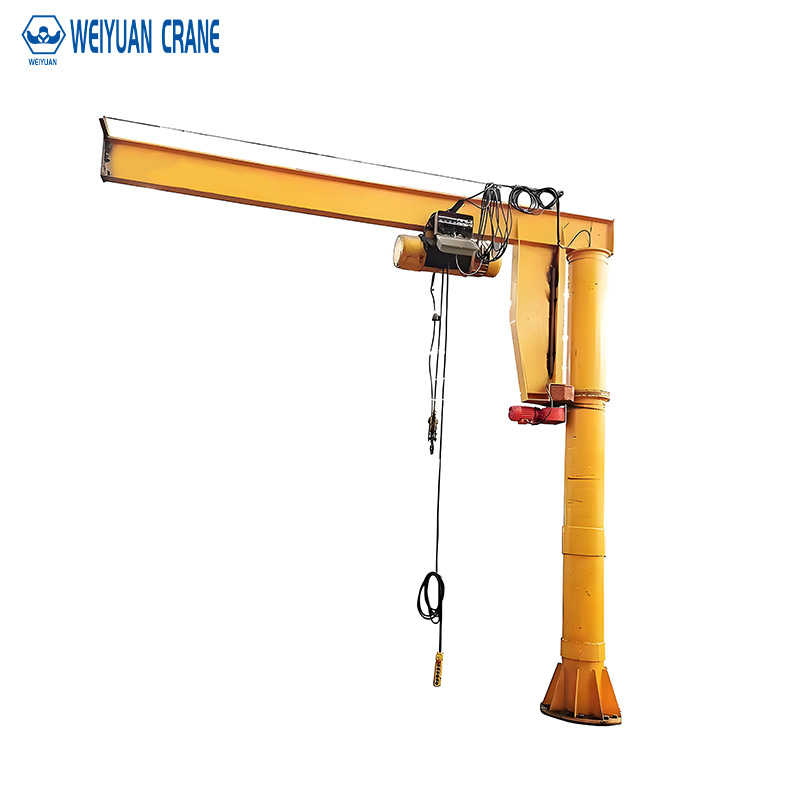
Weiyuan Column Jib Crane
The Weiyuan Column Jib Crane is a versatile and cost-effective freestanding lifting solution designed for precise material handling in workshops, assembly lines, and maintenance areas. With a full 360-degree slewing range and robust steel structure, this crane delivers smooth rotation, dependable performance and enhanced operational flexibility in confined workspaces. :contentReference
View Product / Get QuoteA jib crane is a rotating lifting arm — the jib or boom — mounted on either a wall bracket or a free-standing floor column, with a hoist and trolley traveling along the arm to move a load within a fixed radius. Unlike a bridge crane or gantry crane, which cover a rectangular area defined by a span and a runway or rail length, a jib crane covers a circular or partial-circular arc defined by its arm length and rotation range.
Because a jib crane’s coverage is centered on one point rather than spread across a bay, it’s the standard choice for dedicated, repetitive lifting at a single workstation — where a shared overhead crane would mean waiting for availability, and a full monorail network would be more coverage than one station needs.
Typical capacity range: 125 kg–10 tonnes, depending on mounting type and arm length. Signature strengths: dedicated, always-available coverage at one location; fast installation; space efficiency. Core purpose: localized, repetitive lifting at machine tools, assembly benches, and loading points.
Takeaway: A jib crane covers a fixed radius around a mounting point, giving dedicated, always-available lifting at one workstation — the tool of choice wherever a shared bridge crane or full monorail network would be more coverage than the job needs.
How a Jib Crane Differs From a Bridge Crane or Gantry Crane
Before comparing jib crane types, it’s worth understanding why a facility chooses a jib crane over a full-coverage overhead crane in the first place.
Coverage Shape
A bridge crane or gantry crane covers a rectangle — the span by the runway or rail length. A jib crane covers a circle or arc — the arm’s radius, rotated through its available range. This is the fundamental difference, and it’s what makes a jib crane the right tool for one workstation rather than a whole bay.
Dedicated vs. Shared Availability
A jib crane belongs to one workstation and is always available there. A shared bridge crane covering a whole bay has to be walked to wherever it’s needed next, which means real wait time at high-frequency stations — exactly the bottleneck a dedicated jib crane eliminates.
Installation and Building Dependency
A wall-mounted jib crane needs only a qualified wall or column to attach to; a floor-mounted jib crane needs only a foundation pad. Neither requires the runway beams a bridge crane needs or the ground-level rail a gantry crane needs, which generally makes jib crane installation faster and less disruptive.
Capacity Range
Jib cranes typically top out lower than bridge or gantry cranes — most industrial jib cranes fall in the 0.25 to 10 tonne range, suited to workstation-level lifting rather than bay-wide heavy industrial loads.
Takeaway: A jib crane trades the full-bay coverage of a bridge or gantry crane for dedicated, always-available lifting at one workstation, with simpler installation and a lighter-duty capacity range.
The Main Jib Crane Types
Jib cranes split first by mounting method — wall-mounted vs. floor-mounted — and then by arm configuration. The right choice depends on available space, rotation needs, and whether a suitably rated wall already exists.
Wall-Mounted Jib Crane
A wall-mounted jib crane attaches to a wall bracket or an existing qualified column, rotating up to 180° around that mounting point. It’s generally the more economical option where adequate wall support already exists.
- Coverage: up to 180° rotation around the wall mounting point
- Typical capacity: 125 kg–5 tonnes
- Strengths: lower installation cost where a rated wall exists, no separate foundation needed
- Best for: workstations along a building perimeter or existing column line
Floor-Mounted (Pillar/Free-Standing) Jib Crane
A floor-mounted jib crane — also called a pillar jib crane or free-standing jib crane — stands on its own foundation, independent of any wall, and can rotate a full 270°–360° around its column.
- Coverage: full 270°–360° rotation, independent of building walls
- Typical capacity: 0.5–10 tonnes
- Strengths: full rotation range, no dependency on wall structure, can be positioned anywhere a foundation pad fits
- Best for: workstations in the middle of a floor plan, or where no suitably rated wall exists nearby
Mast-Style (Building-Column-Mounted) Jib Crane
A mast-style jib crane ties into an existing building column rather than a dedicated wall bracket or free-standing foundation, offering a middle ground between wall-mounted and floor-mounted configurations.
- Coverage: rotation range similar to wall-mounted, tied to the building column’s location
- Typical capacity: 0.25–5 tonnes
- Strengths: uses existing structure, avoiding a new foundation pad
- Best for: facilities with a conveniently located, adequately rated building column near the workstation
Articulating Jib Crane
An articulating jib crane adds a second, hinged arm section, letting the crane reach around obstructions or into spaces a straight-arm jib crane can’t access directly.
- Coverage: extended reach around obstacles, at the cost of some rated capacity compared to an equivalent straight-arm unit
- Typical capacity: 125 kg–2 tonnes
- Strengths: navigates around machinery, columns, or other obstructions within the work area
- Best for: tight or irregularly shaped workstations where a straight arm can’t reach the full working area
Takeaway: Wall-mounted and mast-style jib cranes use existing structure and cover up to 180°; floor-mounted (pillar) jib cranes stand independently and cover up to full 360°; articulating jib cranes trade some capacity for the ability to reach around obstructions.
Key Components of a Jib Crane
A jib crane’s performance comes from how its structural and lifting components work together.
Mast or Column
The mast (floor-mounted) or wall bracket (wall-mounted) is the structural backbone the jib arm rotates around. Its design accounts for both the rated load and the moment loading created by full-radius rotation — a different structural calculation than a simple vertical load.
Jib Arm (Boom)
The jib arm — also called the boom — is the horizontal (or near-horizontal) structural member the hoist trolley travels along, and its length sets the crane’s working radius.
Trolley and Hoist
The trolley rides along the jib arm, carrying the hoist that performs the lift. As with any overhead lifting system, hoist selection — electric chain hoist for most workstation applications, or manual chain hoist for light, occasional use — is matched to the crane’s rated capacity.
Rotation Bearing
The rotation bearing at the base of the mast or wall bracket is what allows the arm to swing through its rated rotation range smoothly, under load, without binding.
Rotation Stops
Mechanical rotation stops limit the arm’s swing to its designed range, preventing over-rotation that could damage the structure or create a safety hazard at the edge of the crane’s coverage.
Control System
Jib cranes are typically controlled via pendant control on the hoist, with radio remote control available as a common upgrade for operator mobility around the workstation.
Takeaway: Mast or wall bracket, jib arm, trolley, hoist, rotation bearing, and rotation stops work together as one system — and the mast/bracket’s structural design around moment loading is what separates a correctly engineered jib crane from an underbuilt one.
Comparing Jib Crane Types at a Glance
| Jib crane type | Mounting | Rotation | Typical capacity | Best for |
|---|---|---|---|---|
| Wall-mounted jib crane | Wall bracket or column | Up to 180° | 125 kg–5 t | Perimeter workstations with existing wall support |
| Floor-mounted (pillar) jib crane | Free-standing foundation | 270°–360° | 0.5–10 t | Mid-floor workstations, full-rotation needs |
| Mast-style jib crane | Existing building column | Up to 180° | 0.25–5 t | Facilities with a conveniently located column |
| Articulating jib crane | Wall or floor | Extended reach around obstacles | 125 kg–2 t | Tight or irregularly shaped work areas |
How to Read the Table
Start with what’s physically available at the workstation: an adequately rated wall or column points to wall-mounted or mast-style; no suitable wall points to floor-mounted. Then confirm whether you need full 360° coverage (floor-mounted) or whether up to 180° is enough (wall-mounted/mast-style), and whether obstructions in the work area call for an articulating arm.
Takeaway: Available wall or column structure narrows mounting type; required rotation range and any obstructions in the work area narrow the rest.
Typical Applications for Jib Cranes
Machine Tool Loading
Jib cranes positioned at individual CNC machines, presses, or lathes let one operator load and unload heavy workpieces without waiting for a shared bridge crane, directly cutting per-cycle time at that station.
Assembly and Fabrication Cells
A floor-mounted jib crane covering a full assembly or welding cell gives an operator reach to any point within the cell, useful where parts need to be positioned from multiple angles during the work.
Maintenance Bays
Jib cranes at fixed maintenance bays handle recurring component removal and installation — a common application alongside a low-headroom hoist where bay clearance is limited.
Loading Docks and Warehouse Pick Stations
Wall-mounted jib cranes at loading docks and pick stations handle repetitive lifting of heavy cartons or containers, often working alongside a KBK modular track network covering the broader warehouse workflow.
Takeaway: Jib cranes serve machine tool loading, assembly and fabrication cells, maintenance bays, and loading docks — anywhere one workstation needs dedicated, always-available lifting.
Frequently Asked Questions
Q: What is a jib crane? A jib crane is a rotating lifting arm — the jib or boom — mounted on a wall bracket or a free-standing floor column, with a hoist and trolley traveling along the arm to move a load within a fixed radius. Unlike a bridge or gantry crane, which cover a rectangular area, a jib crane covers a circular or partial-circular arc centered on its mounting point, typically ranging from 125 kg to 10 tonnes in capacity.
Q: What’s the difference between a wall-mounted and a floor-mounted jib crane? A wall-mounted jib crane attaches to a wall bracket or existing building column and rotates up to 180°, generally at lower installation cost where adequate wall support exists. A floor-mounted (or pillar/free-standing) jib crane stands on its own foundation independent of any wall, and can rotate a full 270°–360° — the right choice where no suitable wall exists or full rotation coverage is needed.
Q: How is a jib crane different from an overhead crane or gantry crane? An overhead crane or gantry crane covers a rectangular area — a span by a runway or rail length — serving a whole bay or yard, typically shared across multiple workstations. A jib crane covers a circular or partial-circular arc around a single mounting point, giving one workstation dedicated, always-available coverage rather than a shared resource that has to be walked to wherever it’s needed.
Q: What is an articulating jib crane used for? An articulating jib crane adds a hinged second arm section, letting it reach around machinery, columns, or other obstructions that a straight-arm jib crane can’t navigate around directly — useful in tight or irregularly shaped workstations, at the cost of somewhat lower rated capacity compared to an equivalent straight-arm unit.
Q: How much weight can a jib crane lift? Jib cranes typically range from 125 kg for light precision work up to about 10 tonnes for heavier floor-mounted industrial units. The exact capacity depends on mast or bracket design, arm length, and rotation range — always size to your heaviest actual lift plus hoist weight and a safety margin.
Q: Can a jib crane be installed without major building modification? Yes — this is one of the main advantages of a jib crane over a bridge or gantry crane. A wall-mounted or mast-style unit needs only a qualified existing wall or column; a floor-mounted unit needs only a foundation pad, neither requiring the runway beams or rail infrastructure a full-coverage crane needs.
Q: What industries use jib cranes most? Jib cranes are common in machine shops and CNC manufacturing, assembly and fabrication cells, maintenance bays, and warehouse loading docks and pick stations — any setting where one workstation performs the same lift repeatedly and benefits from dedicated, always-available coverage.