


KBK Crane Buying Guide: How to Choose the Right System for Your Workstation
Introduction
A KBK crane purchase looks deceptively simple — light loads, standard modular parts, bolt it together. That simplicity is exactly why buyers skip questions that matter: whether the roof structure can actually carry the suspended load at every bracket point, whether the layout genuinely needs full-grid coverage or would be better served by a single monorail, and whether the hoist selected actually matches the workstation’s real cycle rate.
This guide walks procurement and plant engineering teams through the real buying decision for a KBK crane system, step by step — the questions to answer before requesting a quote, not just the capacity to specify afterward.
This is article 2 of 3 in the Weiyuan Crane KBK crane series. If you haven’t yet, our KBK crane types and components guide (article 1) is worth reading first — it covers the difference between monorail, single-girder suspension crane, and full grid layouts in more depth than this guide will. Here is what you’ll learn in this one:
- The factors that actually determine the right KBK crane system
- How to size capacity and choose your layout shape
- How support structure and duty cycle change the specification
- A practical checklist to bring to your quotation conversation
Why Capacity Alone Isn’t a Specification
The most common mistake in KBK crane procurement is treating the 2,000 kg ceiling as the whole spec. A “500 kg KBK crane” could be a simple monorail feeding one machine, or a full-grid system covering an entire assembly hall at that same per-lift capacity — same tonnage figure, completely different scope and cost.
A complete specification for a KBK crane system answers several questions beyond capacity: what shape does your work area actually need covered, how is the roof or support structure rated at each suspension point, how many cycles per hour does the workstation actually run, and what hoist type matches that cycle rate. Skip these and you’re relying on the supplier to guess.
Takeaway: Capacity is the starting point for a KBK crane specification, not the whole thing — coverage shape, support structure, and duty cycle all shape which system actually fits.
Step 1: Size the Capacity Correctly
Use Your Heaviest Lift, Not Your Average Lift
Add up your heaviest single load at the workstation, the hoist’s own weight, any lifting attachment or tooling, and a safety margin — never specify to your typical or average lift. Reference the WY-KBK series table in article 1 of this series as a starting point for which profile size matches your load.
Confirm You’re Actually Within KBK Range
If your calculated capacity climbs meaningfully beyond roughly 2,000 kg, a KBK crane is the wrong tool — a heavier single or double girder overhead crane, or a floor-mounted jib crane, is the correct category instead.
Takeaway: Size to your heaviest actual lift plus hoist weight, tooling, and margin, and confirm early whether you’re genuinely within KBK range before specifying a layout.
Step 2: Map Your Coverage Shape
Line, Zone, or Whole Floor?
Ask where the lifting actually happens. A single path or line — feeding one machine, transferring between two fixed points — points to a monorail, the simplest and most economical layout. A defined rectangular work zone, where the load needs to reach any point within a cell, points to a single-girder suspension crane. Lifting needed across a large floor or multiple zones points to a full grid.
Don’t Default to the Biggest Layout
A common overspecification mistake is choosing a full grid when a monorail or single suspension crane would cover the actual workflow — map the real movement pattern before assuming you need maximum coverage.
Takeaway: Map your actual load movement pattern before choosing a layout — most workstations need less coverage than a full grid provides.
Step 3: Verify Your Support Structure
A KBK crane hangs from the roof or a support frame, so confirming that structure can carry the suspended load — at the required suspension bracket spacing — is essential before finalizing a layout.
Existing Roof Structure
Where the roof was engineered with adequate load capacity, suspension brackets can typically attach directly, following the manufacturer’s bracket-spacing requirements for your chosen track profile.
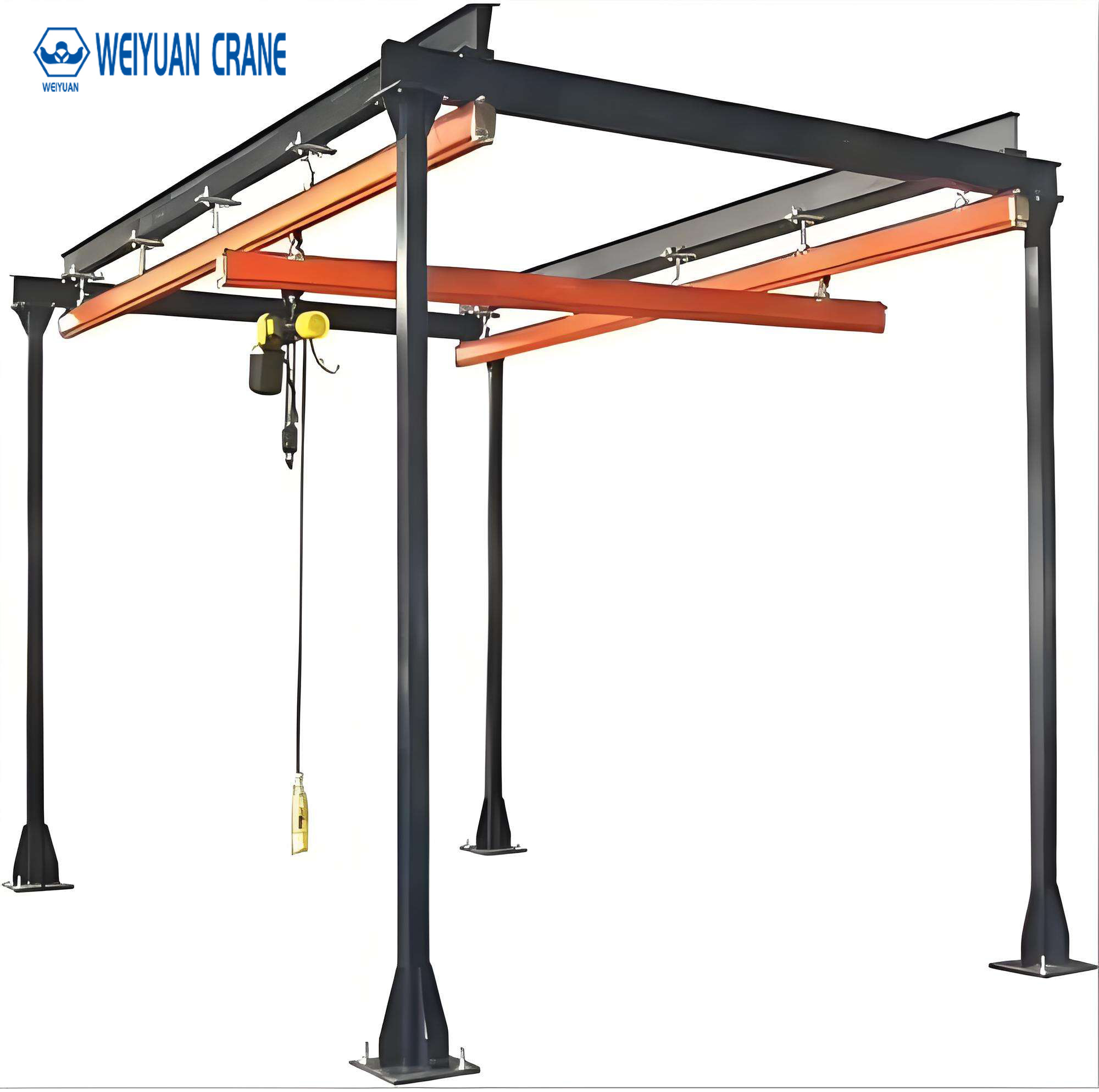
Freestanding Support Frame
Where the roof cannot take the suspended load, a freestanding support frame carries the system instead — this adds cost and should be identified early, not discovered mid-project.
Takeaway: Verify your roof or support structure’s load rating at every planned bracket point before finalizing your layout — this is the step most likely to be skipped and most costly to correct later.
Step 4: Match Duty Cycle to Hoist Selection
Low-Cycle, Precision Work
Occasional or precision-focused lifting suits a manual or air-balanced hoist, maximizing the ergonomic, effortless-feel advantage that makes KBK systems popular for delicate positioning work.
High-Cycle, Repetitive Work
High-repetition workstation lifting — hundreds of cycles a shift — typically justifies an electric chain hoist for consistent speed without operator fatigue accumulating across the shift.
Takeaway: Count your lifts per hour before choosing a hoist type — the ergonomic benefit of manual or air-balanced hoists matters most at high cycle counts, where fatigue would otherwise build fastest.
Step 5: Plan for Future Reconfiguration
Since one of KBK’s core advantages is reconfigurability, it’s worth asking during the buying stage whether your production layout is likely to change — and if so, specifying extra track length, switch points, or connector capacity now can save a second project later.
Takeaway: If your layout may change, factor future reconfiguration into your initial specification — it’s cheaper to plan for it now than to retrofit later.
KBK Crane Buying Checklist
- Heaviest actual lift at the workstation, plus hoist weight, tooling, and safety margin
- Confirmed capacity sits within the ~2,000 kg KBK range
- Mapped coverage shape (line, zone, or whole floor)
- Verified roof or support-frame load rating at planned suspension points
- Confirmed lift frequency / duty cycle to guide hoist selection
- Hoist type preference (manual, air-balanced, or electric chain)
- Anticipated future layout changes, if any
Frequently Asked Questions
Q: What’s the biggest mistake buyers make when specifying a KBK crane? Not verifying the roof or support structure’s load rating at every planned suspension bracket point before finalizing the layout — this is the check most often skipped, and it’s far more expensive to correct after installation than to confirm beforehand.
Q: Do I need a full grid layout, or will a monorail work? Most workstations need less coverage than a full grid provides. Map your actual load movement pattern first — a single line of movement points to a monorail, a defined work zone points to a single-girder suspension crane, and only genuinely floor-wide lifting needs justify a full grid.
Q: How do I know if my roof can support a KBK crane? This requires confirming the roof structure’s load rating at each planned suspension bracket point against the manufacturer’s spacing and load data for your chosen track profile — don’t assume adequate capacity without this verification, especially in older buildings.
Q: Should I choose a manual, air-balanced, or electric chain hoist? Occasional or precision-focused lifting suits manual or air-balanced hoists, maximizing the ergonomic advantage. High-repetition workstation lifting — hundreds of cycles per shift — typically justifies an electric chain hoist for consistent speed without accumulating operator fatigue.
Q: Can I add to a KBK crane layout after the initial installation? Yes — this is one of the main advantages of the bolt-together design. If you anticipate future changes, it’s worth specifying some extra track length, switch points, or connector capacity at the outset, since planning for reconfiguration up front is more cost-effective than retrofitting later.
Q: What information should I have ready before requesting a quote? The checklist above — heaviest lift, confirmed capacity range, mapped coverage shape, support structure verification, duty cycle, hoist preference, and any anticipated future layout changes. Suppliers can quote faster and more accurately with this information up front.