


KBK Crane Systems: Types, Components, and Applications Guide
Introduction
Watch an assembly line for an hour and you will see the same lift happen dozens of times — an operator reaching for a part, guiding it into place, releasing it, and reaching again. Multiply that by a full shift and you have thousands of repetitions. If each one takes a hard shove or an awkward pull, the cost shows up as fatigue, slower cycles, and a workstation that fights the people using it.
This is exactly where a KBK crane system earns its place. Unlike a heavy bridge crane built to move tonnes across a bay, a KBK crane is a light, modular crane system built around one job: making repetitive, station-based lifting smooth, ergonomic, and easy to reconfigure. It is the tool you reach for when the load is light, the work is repetitive, and the layout might change next quarter.
For plant engineers and procurement managers, knowing how KBK crane systems are built and where they fit is the first step to specifying the right one. This guide maps the main KBK layouts, breaks down the components, and gives you a practical framework for matching a system to your workstation.
This is article 1 of 3 in the Weiyuan Crane KBK crane series. Here is what you will learn:
- What a KBK crane system is and how it differs from a traditional overhead crane
- The main KBK layouts — monorail, single-girder suspension crane, and full grid
- The key components and how they bolt together
- Which applications KBK systems serve best, and how to match one to your needs
What a KBK Crane System Is
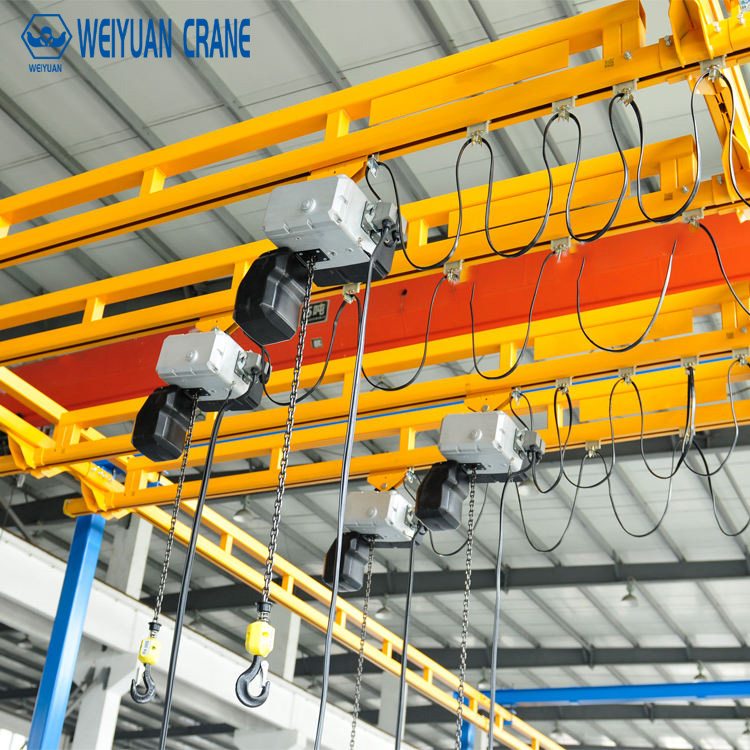
KBK is a modular light crane system built from standardized components — enclosed track profiles, trolleys, connectors, and suspension brackets — that bolt together into a lifting layout. The name comes from the German Kranbaukasten, meaning “crane construction kit,” and that phrase captures the whole idea: you assemble a crane from a kit of standard parts rather than fabricating a one-off structure.
A KBK crane suspends its track from the roof structure or a supporting frame, so the load hangs below an enclosed profile. A trolley rides inside or along that profile, carrying a hoist or a load directly. Because the joints are bolted rather than welded, the layout can be extended, shortened, rerouted, or relocated as production changes — without cutting steel.
Typical capacity: up to around 2,000 kg (2 tonnes). Signature strengths: light weight, low headroom, low rolling friction, and effortless hand-pushed movement. Core purpose: ergonomic, repetitive lifting at workstations and along assembly lines.
Takeaway: A KBK crane is a bolt-together modular crane system for light, repetitive lifting — flexible, ergonomic, and built to be reconfigured rather than replaced.
How a KBK Crane Differs From a Traditional Overhead Crane
KBK sits at the lightest end of the overhead crane family, and its whole design philosophy diverges from a standard bridge crane. Understanding the difference stops you from specifying the wrong tool for the job.
Construction and Flexibility
A traditional overhead crane is a fabricated, largely permanent structure — welded girders on a fixed runway engineered into the building. A KBK crane system is a bolted kit of standard modules. That single difference drives everything else: a KBK layout can be reconfigured, extended, or moved to a new bay as your process evolves, while a bridge crane stays where it was built.
Capacity and Duty
A bridge crane carries heavy loads — from a few tonnes to several hundred — across a whole bay. A KBK crane handles light loads up to around 2 tonnes over a workstation or line. Ask a KBK system to do heavy bay-wide work and it will not cope; ask a bridge crane to do fine, hand-guided station lifting and you overpay for capacity you never use.
Operation and Ergonomics
A bridge crane is powered and positioned by controls. A KBK crane’s signature is the hand-pushed glide — an operator moves the load along low-friction enclosed track with a light push, cycle after cycle, with far less strain. This ergonomic advantage is the reason KBK dominates assembly-line and workstation lifting.
Headroom and Weight
The enclosed track profile is light and compact, so a KBK crane consumes little vertical space and imposes modest loads on the roof structure. A top-running bridge crane needs a column-supported runway and eats more headroom.
Takeaway: A bridge crane is a heavy, permanent, powered machine for bay-wide lifting; a KBK crane is a light, modular, hand-guided system for reconfigurable station work. Match the tool to the load and the workflow.
The Main KBK Crane Layouts
KBK systems come in three main layouts, each covering a different shape of work area. The right one depends on whether your lifting happens along a line, across a zone, or over a full floor.
Monorail
A monorail is the simplest KBK layout — a single enclosed track running in a straight line, with a trolley and hoist traveling along it. The load moves back and forth along one axis.
- Coverage: a straight line (can curve or branch)
- Strengths: the most economical layout, simple to install and extend
- Best for: moving parts along an assembly line, feeding a machine from a fixed point, or transferring loads between two stations
A monorail can follow a curve, branch through switches, and connect to other tracks, so even this simplest form can route material along a production path rather than a straight run alone.
Single-Girder Suspension Crane
A single-girder suspension crane adds a second axis. A KBK bridge girder is suspended from two parallel runway tracks and travels along them, while the hoist trolley moves across the girder. The result is coverage of a rectangular zone rather than a single line.
- Coverage: a rectangular area
- Strengths: full coverage of a defined work zone, still light and hand-guided
- Best for: a workstation or cell where the load must reach any point within a rectangle — assembly cells, machining stations, and packing areas
Full Grid (Multiple-Bridge) Layout
A full grid extends the suspension-crane idea across a large floor. Several bridge girders run on a shared network of parallel runways, so multiple cranes cover adjacent zones — or a load transfers from one bridge to the next across the whole area.
- Coverage: a full floor or a large multi-zone area
- Strengths: continuous coverage across a big space, with several operators working independent zones under one system
- Best for: large assembly halls, multi-station production lines, and facilities needing light lifting everywhere on the floor
Takeaway: Monorail covers a line, a single-girder suspension crane covers a zone, and a full grid covers a whole floor. Match the layout to the shape of the area your work actually spans.
Key Components of a KBK Crane System
A KBK crane’s flexibility comes from its standardized parts. Each does a specific job, and because they bolt together, the whole layout can be assembled, adjusted, and reconfigured on site.
Enclosed Track Profiles
The enclosed track is the backbone of the system — the rail the trolleys run inside. Its enclosed shape protects the running surface from dust and debris, which keeps rolling resistance low and the hand-push effortless year after year. Profiles come in a range of sizes, and the profile you choose sets the system’s capacity and span: a larger profile carries more load and bridges a longer unsupported span before it needs another suspension point.
Trolleys
Trolleys are the rolling elements that travel inside the track. A hoist trolley carries the hoist along the track; an end trolley connects a bridge girder to its runway. Low-friction wheels are what make the KBK glide possible — a light push moves the load, sparing the operator the strain of a stiff, heavy carriage.
Connectors and Suspension Brackets
Connectors join track sections end to end, letting you build a run of any length or reroute it later. Because they bolt, a run can be extended or shortened without fabrication.
Suspension brackets hang the track from the roof structure or a support frame. Their spacing is set by the load and the profile — heavier loads and longer spans need closer suspension points. Correct bracket spacing is central to keeping the track straight and the trolley rolling freely.
Hoists
The hoist does the actual lifting beneath the trolley. On a KBK crane it is typically a light electric chain hoist or, for the lightest and most ergonomic work, a manual or air-balanced hoist. The hoist is matched to the system capacity, and a chain hoist with smooth control keeps the vertical lift as effortless as the horizontal glide.
End Stops and Accessories
End stops at the limits of each track keep the trolley from running off the end. A range of accessories — festoon power supply, articulated jibs, switches, and turntables — extends what a KBK layout can do, letting you route power to a traveling hoist or branch the track between paths.
Takeaway: The enclosed track, trolleys, connectors, suspension brackets, and hoist are the core kit. Because they bolt together, you assemble the exact layout your workstation needs — and change it when the work changes.
Series and Capacity Range
Series name: WY-KBK Series | Category: Modular light crane system, bolt-together enclosed-track profile, monorail/suspension/grid layouts
| Model | Capacity | Track Profile / Typical Span | Typical Applications | Control | Hoist Type |
|---|---|---|---|---|---|
| WY-KBK-I | 80–250 kg | Light profile, up to 4 m between supports | Small parts handling, electronics assembly, precision workstations | Hand-guided / pendant | Manual or light electric chain hoist |
| WY-KBK-II | 250–500 kg | Medium profile, up to 5 m between supports | General assembly lines, packing and kitting stations | Hand-guided / pendant | Electric chain hoist |
| WY-KBK-III | 500 kg–1 ton | Medium-heavy profile, up to 6 m between supports | Automotive sub-assembly, machine loading, warehouse pick stations | Pendant / remote | Electric chain hoist |
| WY-KBK-IV | 1–1.5 tons | Heavy profile, up to 6 m between supports | Metalworking cells, heavier fabrication feed lines | Pendant / remote | Electric chain hoist |
| WY-KBK-V | 1.5–2 tons | Upper limit of standard KBK profile range | Multi-station production lines, heaviest KBK-rated loads | Remote | Electric chain hoist, air-balanced option |
Technical Parameters (Reference Range)
| Parameter | Typical Range / Description |
|---|---|
| Rolling resistance | Low-friction enclosed track, designed for effortless hand-push movement |
| Layout types | Monorail, single-girder suspension crane, full grid (multiple-bridge) |
| Suspension bracket spacing | Set by load and profile size — closer spacing for heavier loads/longer spans |
| Track sections | Straight, curved, and switch/junction sections, all bolt-together |
| Power supply (electric hoist option) | 380V/50Hz (customizable); manual/air-balanced options need no electrical supply |
| Structural verification required | Roof or support-frame load rating at each suspension bracket point |
Typical Applications for KBK Crane Systems
KBK crane systems shine wherever light, repetitive lifting meets a workflow that may change. A few industries rely on them heavily.
Automotive Assembly
The automotive line is KBK’s natural home. Operators lift and position components — dashboards, seats, small subassemblies, tools — hundreds of times a shift. The hand-guided glide and low-friction track cut the strain of that repetition, while the modular layout lets the line be reconfigured as models and processes change. Ergonomic, repeatable motion at speed is exactly what a KBK crane system delivers.
General Manufacturing and Metalworking
In machine shops and fabrication cells, KBK crane systems feed machines, move work between stations, and handle tools and fixtures. A single-girder suspension crane over a machining cell lets one operator reach any point in the work zone without walking a load around. Because the layout bolts together, a shop can add or move a station without a major structural project.
Logistics and Warehousing
In packing, kitting, and order-fulfillment areas, KBK monorails and suspension cranes move cartons, containers, and light loads between conveyors, benches, and pack-out points. The light weight and low headroom suit warehouse buildings, and the ability to reroute the track keeps pace with changing fulfillment layouts.
Workstation and Assembly Cells
Beyond any single industry, KBK crane systems serve dedicated workstations everywhere — a single cell where a repetitive lift needs to be smooth, safe, and precise. This is the fundamental use case: turning a strenuous manual pick into an effortless, controlled motion, cycle after cycle. Many facilities pair a KBK network with a dedicated jib crane at a single high-frequency station within that same layout, covering both the line-wide and single-point lifting needs of the cell.
Takeaway: KBK crane systems fit automotive assembly, manufacturing, metalworking, logistics, and any workstation where light, repetitive lifting meets a layout that may evolve.
Frequently Asked Questions
Q: What is a KBK crane system? A KBK crane system is a modular light crane built from standardized components — enclosed track profiles, trolleys, connectors, and suspension brackets — that bolt together into a lifting layout. The name comes from the German for “crane construction kit.” It suspends its track from the roof or a support frame, and a trolley carrying a hoist rides along the enclosed profile. Because the joints are bolted rather than welded, the layout can be extended, rerouted, or relocated as production changes. KBK crane systems handle light loads, typically up to around 2,000 kg, and are built for ergonomic, repetitive workstation lifting.
Q: How is a KBK crane different from an overhead bridge crane? The core difference is construction and duty. A bridge crane is a fabricated, largely permanent structure that carries heavy loads — from a few tonnes to several hundred — across a whole bay, powered and positioned by controls. A KBK crane system is a bolted kit of standard modules that handles light loads up to around 2 tonnes over a workstation or line, moved by hand along low-friction enclosed track. KBK layouts can be reconfigured and relocated, consume little headroom, and excel at ergonomic, repetitive lifting, while a bridge crane stays where it was built and handles the heavy work.
Q: How much weight can a KBK crane system lift? KBK crane systems typically handle loads up to around 2,000 kg (2 tonnes), spread across the WY-KBK series shown above from 80 kg light-duty units to 2-ton heavy-profile units. The exact capacity depends on the enclosed track profile selected and the suspension bracket spacing — a larger profile carries more load and spans further between supports. Always size to your heaviest lift plus the hoist weight, any tooling, and a safety margin, not the bare load. If your load climbs beyond the KBK range, a heavier crane type such as a single or double girder bridge crane is the correct choice instead.
Q: What are the main types of KBK crane layouts? There are three main layouts. A monorail is a single enclosed track running in a straight line, ideal for line feeding and point-to-point transfer. A single-girder suspension crane suspends a bridge girder from two parallel runways, covering a rectangular work zone for assembly and machining cells. A full grid uses multiple bridge girders on a shared runway network to cover a whole floor or large multi-zone area. All three share the same light-capacity ceiling and hand-guided ergonomics — the difference is whether they cover a line, a zone, or an entire floor.
Q: What are the key components of a KBK crane? The core components are the enclosed track profiles (the rail the trolleys run inside), trolleys (the low-friction rolling elements that carry the hoist or connect a bridge girder to its runway), connectors (which join track sections and allow reconfiguration), suspension brackets (which hang the track from the roof or a support frame), and the hoist (typically a light electric chain, manual, or air-balanced hoist). End stops and accessories such as festoon power supplies, switches, and turntables extend what the layout can do.
Q: What industries use KBK crane systems? KBK crane systems are used most in automotive assembly, where operators position components hundreds of times a shift and the modular layout adapts to model changes. They also serve general manufacturing and metalworking for feeding machines and moving work between stations, and logistics and warehousing for packing, kitting, and order-fulfillment areas. More broadly, they suit any dedicated workstation or assembly cell where light, repetitive lifting needs to be smooth, safe, and precise, and where the layout may change over time.
Q: Why are KBK crane systems considered ergonomic? Their signature is the hand-pushed glide. The enclosed track protects the running surface from dust and debris, keeping rolling resistance very low, so an operator moves the load along the track with a light push rather than a hard shove. Over thousands of repetitions a shift, that low-friction movement dramatically reduces operator strain and fatigue. Paired with a smooth hoist — electric chain, manual, or air-balanced — a KBK crane turns a strenuous manual pick into an effortless, controlled motion, which is exactly why it dominates assembly-line and workstation lifting.
Q: Can a KBK crane layout be changed or expanded later? Yes — this is one of KBK’s biggest advantages. Because the components bolt together rather than being welded, a layout can be extended, shortened, rerouted, or relocated to a new bay as production changes, without cutting steel. You can add a station, branch the track through a switch, or move the whole system to follow a new process. This reconfigurability is why KBK crane systems suit facilities whose layouts evolve, and it is a key reason to choose a modular system over a fixed, fabricated crane for light station work.