


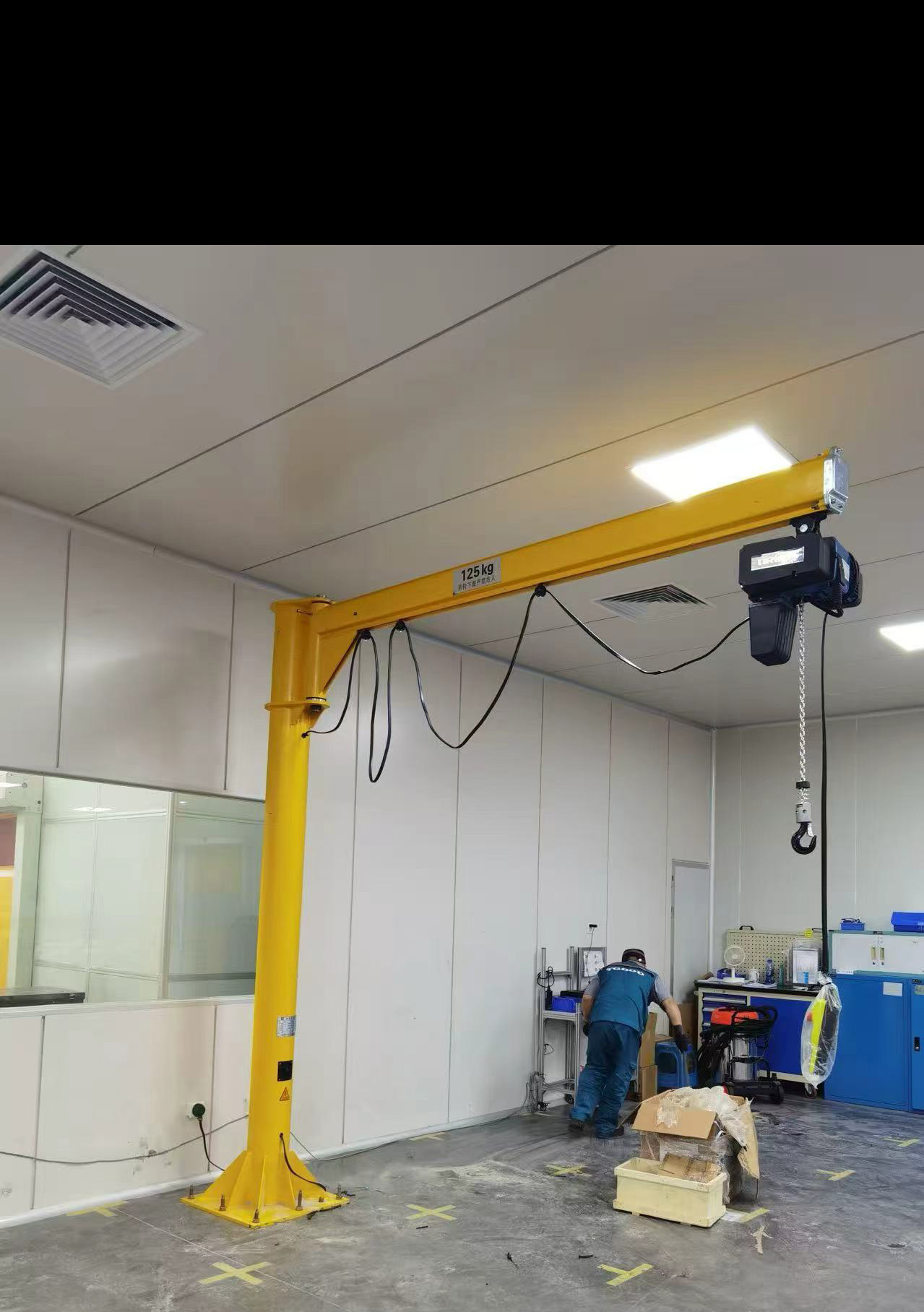
Jib Crane
Articulating Jib Crane for Sale: Reaching Around Obstacles a Straight Arm Can’t Clear
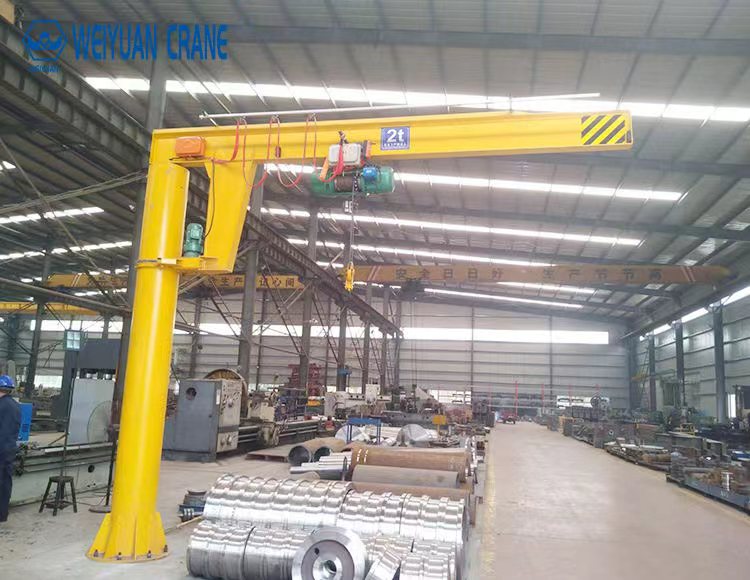
An articulating jib crane solves a problem no straight-arm jib crane can: a workstation where a machine, column, or other obstruction sits squarely inside the working radius, blocking a straight arm from reaching the far side of the area it needs to cover. By adding a hinged second arm section, an articulating jib crane can bend around that obstruction — at the cost of some rated capacity compared to an equivalent straight-arm unit, which is exactly the trade-off worth understanding before you specify one.
Weiyuan’s articulating jib crane range covers 125 kg to 2 tons, engineered around the customer’s actual obstruction layout and reach requirements.
What Makes an Articulating Jib Crane Different
A standard jib crane — wall-mounted or floor-mounted — uses a single straight arm rotating around its mounting point. An articulating jib crane adds a hinged joint partway along the arm, creating a second segment that can fold or extend independently, letting the crane’s reach bend around machinery, support columns, or other fixed obstructions that would otherwise block a straight arm entirely.
This added mechanical complexity comes with a capacity trade-off: articulating jib cranes generally top out lower than an equivalent straight-arm wall-mounted or floor-mounted jib crane, since the hinged joint introduces additional loading considerations the single-arm design doesn’t have.
Articulating Jib Crane Configurations
Wall-Mounted Articulating Crane
Combines a wall or column mounting point with a hinged second arm section, for perimeter workstations with a nearby obstruction.
- Capacity: 125–1,000 kg
- Best for: perimeter workstations where a column or fixture blocks part of a straight arm’s swing
Floor-Mounted Articulating Crane
Combines a free-standing foundation mount with a hinged arm, for mid-floor workstations needing to reach around obstacles across a larger working area.
- Capacity: 250 kg–2 tons
- Best for: fabrication cells or work areas with equipment positioned within the crane’s natural swing radius
Manual vs. Powered Articulation
Some articulating jib cranes fold manually, with the operator guiding the second arm section by hand; others use a powered articulation mechanism for heavier loads or more frequent repositioning. Manual articulation is typically sufficient for lighter, less frequent obstacle-navigation needs.
Featured Product: Weiyuan AJ-Series Articulating Jib Crane
[Product image placeholder]
The Weiyuan AJ-Series is available in wall-mounted and floor-mounted configurations from 125 kg to 2 tons, with arm segment lengths engineered around the customer’s specific obstruction layout.
[View Product / Get Quote →]
How to Choose the Right Articulating Jib Crane
- Confirm a straight-arm jib crane genuinely can’t cover your workstation — articulating cranes cost more and carry less capacity than an equivalent straight-arm unit, so this should be a real constraint, not an assumption.
- Map the exact obstruction location relative to your intended mounting point, so the arm segment lengths can be engineered to route around it correctly.
- Size capacity to your heaviest actual lift, accounting for the lower capacity ceiling of an articulating design versus a straight arm.
- Decide manual vs. powered articulation based on how heavy the load is and how frequently the arm needs to reposition around the obstruction.
- Confirm mounting structure (wall or floor) using the same verification process as a standard jib crane of that mounting type.
Red Flags When Shopping for an Articulating Jib Crane
- A supplier recommending articulation without confirming a straight-arm unit truly can’t work — this added complexity and cost should be justified by an actual obstruction, not sold as a default upgrade.
- No obstruction layout discussion during specification — the whole point of an articulating design is routing around a specific obstacle, so a proposal that doesn’t address the actual obstruction location is incomplete.
- Capacity quoted without acknowledging the reduction versus an equivalent straight-arm unit — buyers should understand this trade-off clearly before ordering.
- No distinction offered between manual and powered articulation — these serve different use cases, and a supplier should ask about your load weight and repositioning frequency.
Frequently Asked Questions
Q: When do I need an articulating jib crane instead of a standard straight-arm unit? When a machine, column, or other fixed obstruction sits within the working radius a straight arm would need to sweep through — a straight-arm jib crane simply can’t route around an obstacle in its path, which is exactly what the hinged second arm section of an articulating design is built to do.
Q: Does an articulating jib crane lift less than a standard jib crane? Generally yes, at an equivalent arm length — the hinged joint introduces additional structural and loading considerations that reduce the achievable capacity compared to a straight-arm wall-mounted or floor-mounted jib crane of similar size.
Q: Can an articulating jib crane be wall-mounted or does it need a floor mount? Both configurations are available — an articulating arm can be paired with either a wall-mounted or floor-mounted base, following the same mounting-structure verification process as a standard jib crane of that type.
Q: What’s the difference between manual and powered articulation? Manual articulation relies on the operator physically guiding the hinged arm section into position, suited to lighter loads and infrequent repositioning. Powered articulation uses a motorized mechanism, better suited to heavier loads or workstations where the arm needs to reposition frequently throughout a shift.
Q: How much more does an articulating jib crane cost than a standard jib crane? It varies by capacity and configuration, but the added hinge mechanism and reduced capacity ceiling generally make an articulating jib crane more expensive than an equivalent-capacity straight-arm unit — a cost that’s usually justified only where an obstruction genuinely requires it.