


Gantry crane
Double Girder Gantry Crane for Sale: Higher Capacity and Lower Hook Approach
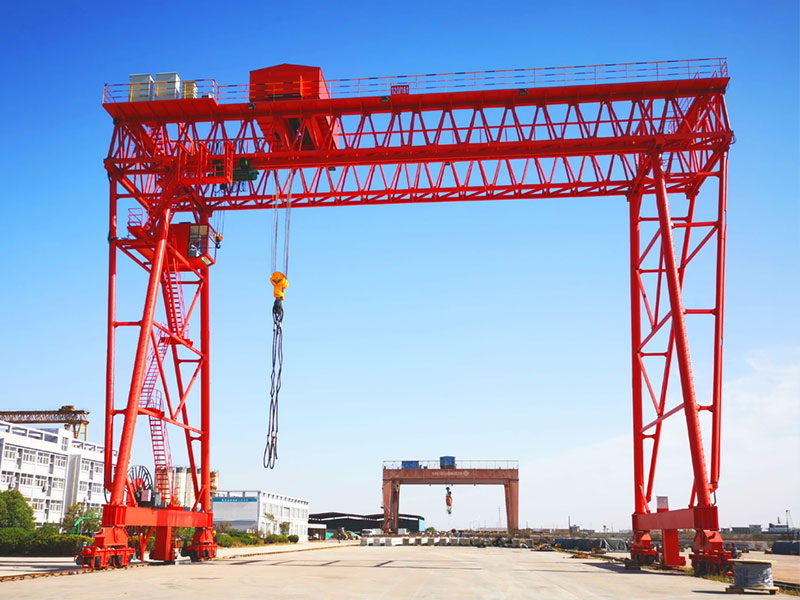
A double girder gantry crane earns its place once a single girder design can’t clear two hurdles at once: enough capacity, and enough usable lift height beneath the structure. Running twin parallel girders lets the trolley and hoist sit on top of the structure rather than beneath a single beam, which both raises the achievable capacity ceiling and lowers the hook’s approach to the ground — a combination that matters enormously in shipyard halls, steel mills, and any facility where headroom is already tight.
Weiyuan engineers double girder gantry cranes from 20 to 500 tons, specified to the customer’s actual capacity, span, and headroom requirements rather than a fixed catalogue configuration.
What Makes a Double Girder Gantry Crane Different
Compared to a single girder gantry crane, a double girder gantry crane uses two parallel structural girders between the legs, with the hoist trolley traveling across the top of both. This structural difference does two things at once: it distributes load across a wider structural base, enabling higher rated capacities than a single girder design at an equivalent span, and it lowers the hook’s approach to ground level for a given leg height, since the trolley isn’t hanging beneath a single beam.
The trade-off is cost and complexity — more structural steel, a heavier overall structure, and typically a longer fabrication and installation timeline than an equivalent-span single girder gantry crane. This is why double girder designs are specified where the capacity or headroom requirement genuinely calls for them, not as a default upgrade.
Double Girder Gantry Crane Configurations
Standard Industrial Double Girder Crane
The baseline configuration for facilities that have outgrown single girder capacity limits but don’t require heavy-duty shipyard or mill-scale tonnage.
- Capacity: 20–50 tons
- Span: 15–30 meters
- Best for: general industrial yards, larger stockyards, mid-scale fabrication
Shipyard and Marine Fabrication Double Girder Crane
Engineered for hull-section and module lifts, often with dual-hoist configurations for combined heavy and precision lifting.
- Capacity: 100–500 tons
- Configuration: full gantry, dual-hoist option
- Best for: shipyard hull-assembly halls, offshore fabrication yards
Steel Mill Double Girder Crane
Sized around the mill’s heaviest single lift, typically fitted with a specialized attachment — coil, ladle, or ingot handling — rather than a standard hook.
- Capacity: 50–200 tons
- Configuration: full or semi-gantry depending on site structure
- Best for: steel rolling mills, foundries, metals processing plants
Low-Headroom Double Girder Configuration
Where even a double girder design’s standard hook approach isn’t enough for a genuinely tight-clearance building, a low-headroom trolley configuration can recover additional usable lift height.
- Best for: retrofit projects and older buildings where roof or leg clearance is fixed and can’t be modified
Featured Product: Weiyuan DG-Series Double Girder Gantry Crane
[Product image placeholder]
The Weiyuan DG-Series is engineered to order from 20 to 500 tons, with dual-hoist and low-headroom trolley options available. Recent projects include shipyard hull-assembly cranes and steel mill coil-handling units, each specified around the customer’s heaviest lift and site headroom.
[View Product / Get Quote →]
How to Choose the Right Double Girder Gantry Crane
- Confirm you actually need double girder capacity or headroom benefits — if your load is comfortably within single girder gantry crane range and headroom isn’t constrained, a single girder design may be the more cost-effective choice.
- Measure your actual site headroom, particularly if hook approach is a driving factor in your decision, not just raw capacity.
- Decide on dual-hoist vs. single-hoist, based on whether your lift profile includes both heavy lifts and frequent lighter, faster positioning work.
- Confirm span and leg configuration (full vs. semi-gantry) against your actual site structure and dimensions.
- Engage engineering input early for capacities above roughly 100 tons, where foundation and structural design become as significant as the crane specification itself.
Red Flags When Shopping for a Double Girder Gantry Crane
- A double girder recommendation with no clear capacity or headroom justification — if a single girder design would meet your needs at lower cost, a supplier should say so rather than defaulting to the more expensive option.
- No foundation or leg-reaction load data at higher capacities — this is essential for accurate site preparation budgeting.
- Vague duty class — a double girder gantry crane’s service life depends heavily on matching duty class to actual usage, not just peak tonnage.
- No discussion of hoist configuration (single vs. dual) despite a lift profile that clearly includes both heavy and light, frequent lifts — this is a common missed-value conversation in double girder quotations.
Frequently Asked Questions
Q: When do I need a double girder gantry crane instead of a single girder one? When your capacity requirement exceeds roughly 30 tons, or when you need the lower hook approach a double girder design provides — typically in headroom-constrained buildings or applications like shipyard hull-assembly halls where every centimeter of usable lift height matters.
Q: How much more does a double girder gantry crane cost than a single girder crane? It varies by capacity and span, but double girder designs generally cost more due to the additional structural steel and typically longer fabrication and installation timeline — the premium is usually justified only where the extra capacity or lower hook approach is genuinely needed.
Q: Can a double girder gantry crane have two hoists? Yes — a dual-hoist configuration, pairing a heavy main hoist with a faster, lighter auxiliary hoist, is a common option on double girder gantry cranes, particularly in shipyard and heavy-fabrication applications with a mixed lift profile.
Q: What’s the maximum capacity for a double girder gantry crane? Double girder gantry cranes are engineered up to 500 tons and beyond for the heaviest shipyard and industrial fabrication applications, though most industrial and general-yard applications fall well below that ceiling, typically in the 20–200 ton range.
Q: Do double girder gantry cranes always use rail-mounted travel? No — double girder gantry cranes can be specified with either rail-mounted or rubber-tyred travel, following the same logic used for single girder designs: fixed, repeatable lanes favor rail, while flexible repositioning favors rubber tyres.
