


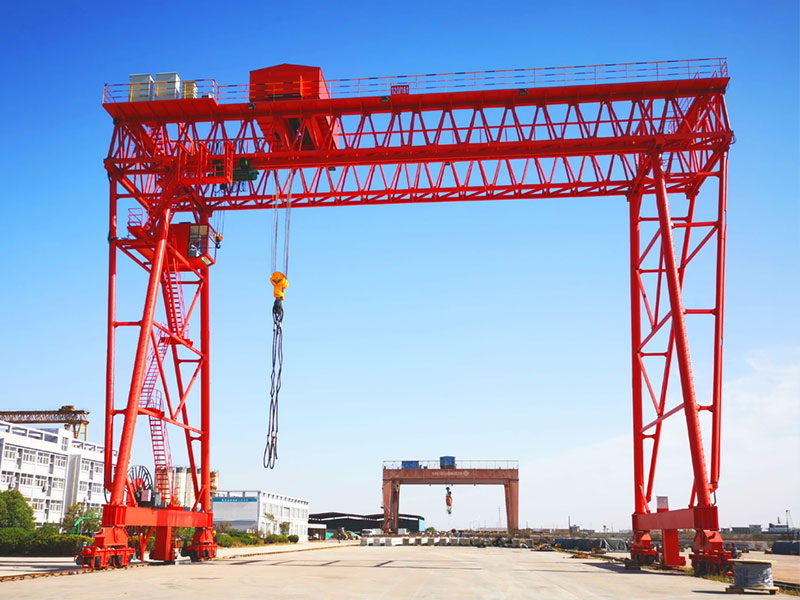
Gantry crane
Heavy Duty Gantry Crane for Sale: Engineered for Shipyard and Industrial-Scale Lifting
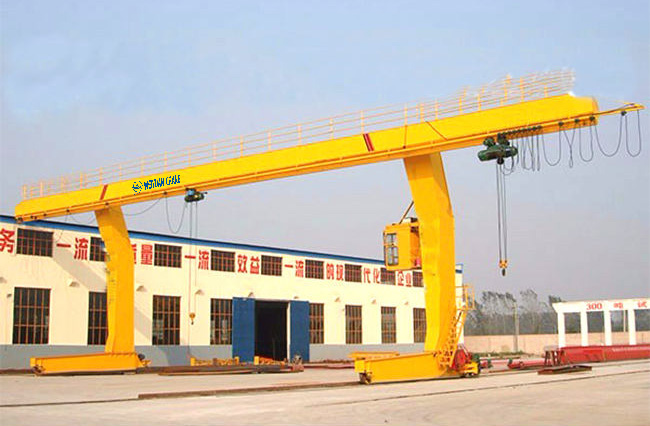
A heavy duty gantry crane isn’t a bigger version of a light workshop crane — it’s a different engineering problem entirely. Once capacity climbs into the tens or hundreds of tons, foundation design, girder configuration, and duty class all become project-specific decisions rather than catalogue selections. Buying at this scale without engineering input from the start is how facilities end up with a crane that technically meets the tonnage number but fails on the lift profile that actually matters — a single heaviest component, not an average load.
Weiyuan engineers heavy duty gantry cranes from 50 to 500 tons for shipyards, steel mills, power plants, and heavy fabrication yards, specifying each unit around the customer’s actual heaviest lift rather than a generic capacity tier.
What Makes a Heavy Duty Gantry Crane Different
Below roughly 20–30 tons, a gantry crane is largely a catalogue selection — pick a capacity and span, adjust minor options. Above that range, a heavy duty gantry crane becomes a structural engineering project: girder deflection under load, foundation leg-reaction forces, and duty class (how many heavy lifts per day, at what percentage of rated capacity) all drive the design in ways that a standard single girder gantry crane specification doesn’t need to consider.
This is also where the double girder gantry crane configuration becomes the default rather than an option — the lower hook approach and higher achievable capacity of a double-girder design are usually necessary once loads climb into heavy-duty territory, particularly in shipyard and fabrication-hall applications where roof or leg-height clearance is already tight.
Heavy Duty Gantry Crane Applications and Tiers
Shipyard and Marine Fabrication Gantry Crane
Engineered for hull-section and module lifts, often with dual-hoist configurations pairing a heavy main hoist with a faster auxiliary hoist for lighter positioning work.
- Capacity: 100–500 tons
- Configuration: double girder, full gantry (legs both sides)
- Best for: shipyard hull-assembly halls, offshore module fabrication yards
Steel Mill and Metallurgy Gantry Crane
Sized around the mill’s heaviest single lift — typically a ladle, coil, or ingot — with attachments engineered for the specific handling task rather than a generic hook.
- Capacity: 50–200 tons
- Configuration: double girder, often with specialized lifting attachments
- Best for: steel rolling mills, foundries, metals processing plants
Power Plant and Heavy Equipment Gantry Crane
Specified around a facility’s single heaviest maintenance or assembly lift — a generator, turbine component, or major equipment module — with precision positioning control for delicate placement.
- Capacity: 50–150 tons
- Configuration: double girder, variable-speed hoisting for precision
- Best for: power plant maintenance yards, heavy equipment assembly plants
Featured Product: Weiyuan HD-Series Heavy Duty Gantry Crane
[Product image placeholder]
The Weiyuan HD-Series is engineered to order from 50 to 500 tons, with full structural and foundation-load calculations provided as part of every proposal. Recent configurations include dual-hoist shipyard cranes and single-lift steel mill units, each specified around the customer’s actual heaviest load and duty cycle.
[View Product / Get Quote →]
How to Choose the Right Heavy Duty Gantry Crane
- Identify your single heaviest lift, not an average — heavy duty gantry crane specification should be driven by the worst case, with an appropriate safety margin.
- Determine your duty cycle — occasional heavy lifts and continuous multi-shift heavy lifting require meaningfully different structural and mechanical specifications.
- Confirm your foundation and site conditions early — heavy duty gantry crane foundations are a significant part of total project cost and lead time.
- Decide whether a dual-hoist configuration (heavy main hoist plus faster auxiliary) fits your actual lift profile, or whether a single-hoist design is sufficient.
- Engage structural engineering input early rather than after a capacity number has already been fixed — at this scale, span, foundation, and capacity are interdependent decisions.
Red Flags When Shopping for a Heavy Duty Gantry Crane
- A quote with no foundation load data — at heavy duty capacities, foundation design is not a downstream detail; a proposal without leg-reaction load figures is incomplete.
- No stated duty class — a “200-ton crane” quoted without duty classification could be engineered for very different actual service lives.
- Generic hook only, no discussion of lifting attachments — heavy duty applications (coil handling, ladle handling, hull-section lifting) usually need purpose-built attachments, not a standard hook.
- Unusually short lead times for a fully custom heavy-capacity unit — heavy duty gantry cranes at this scale involve substantial engineering and fabrication time; an unrealistically fast quote is worth questioning.
Frequently Asked Questions
Q: At what capacity does a gantry crane become “heavy duty”? There’s no single industry-wide cutoff, but above roughly 20–30 tons, gantry crane specification increasingly becomes a structural engineering exercise rather than a catalogue selection — foundation design, girder deflection, and duty class all become project-specific rather than standard.
Q: Do heavy duty gantry cranes always use double girders? Not always, but double girder configurations are the default above a certain capacity because they offer higher achievable capacity and a lower hook approach than a single girder gantry crane design — both increasingly important as loads and headroom constraints grow.
Q: How long does it take to get a heavy duty gantry crane? Lead times vary significantly by capacity and customization level, but fully engineered heavy duty units — particularly those in the 100+ ton range — involve substantial design and fabrication time beyond what a catalogue-spec light or medium gantry crane requires. Confirm realistic lead times as part of your quotation, not after ordering.
Q: What’s the difference between a heavy duty gantry crane and a heavy duty overhead crane? The core difference is the same as at lighter capacities — a heavy duty gantry crane carries its own load through legs to the ground, while a heavy duty overhead (bridge) crane depends on a building’s structural steel. At heavy tonnages, this distinction becomes even more consequential, since building structural upgrades for an indoor heavy-capacity overhead crane can be extremely costly compared to a purpose-built gantry crane foundation.
Q: Can an existing heavy duty gantry crane be upgraded to higher capacity? In some cases, structural reinforcement and hoist-system upgrades can increase an existing crane’s rated capacity, though this requires engineering evaluation against the original design margin — it’s not always feasible and should be assessed case by case rather than assumed.
